

By the Water’s Edge Counseling Team
Hello, and welcome. If you have found your way here, it is likely because the “waters” of your home life have begun to feel restless. Perhaps the conversations at your dinner table have grown quiet, or maybe they have grown too loud.
At Water’s Edge Counseling, we believe that your family is a complex, beautiful ecosystem that sometimes loses its alignment. Standing at the edge of the decision to seek help can feel like a risk, but it is the first step toward a life full of peace and renewal.
Quick Insights: The Bottom Line
Families benefit from Christian counseling when experiencing persistent communication breakdowns, spiritual isolation despite shared faith, or the weight of collective trauma. This integrative approach blends evidence-based clinical modalities like EMDR and CBT with a biblical worldview to restore emotional intimacy and spiritual alignment within the home.
What is Integrative Christian Family Counseling?
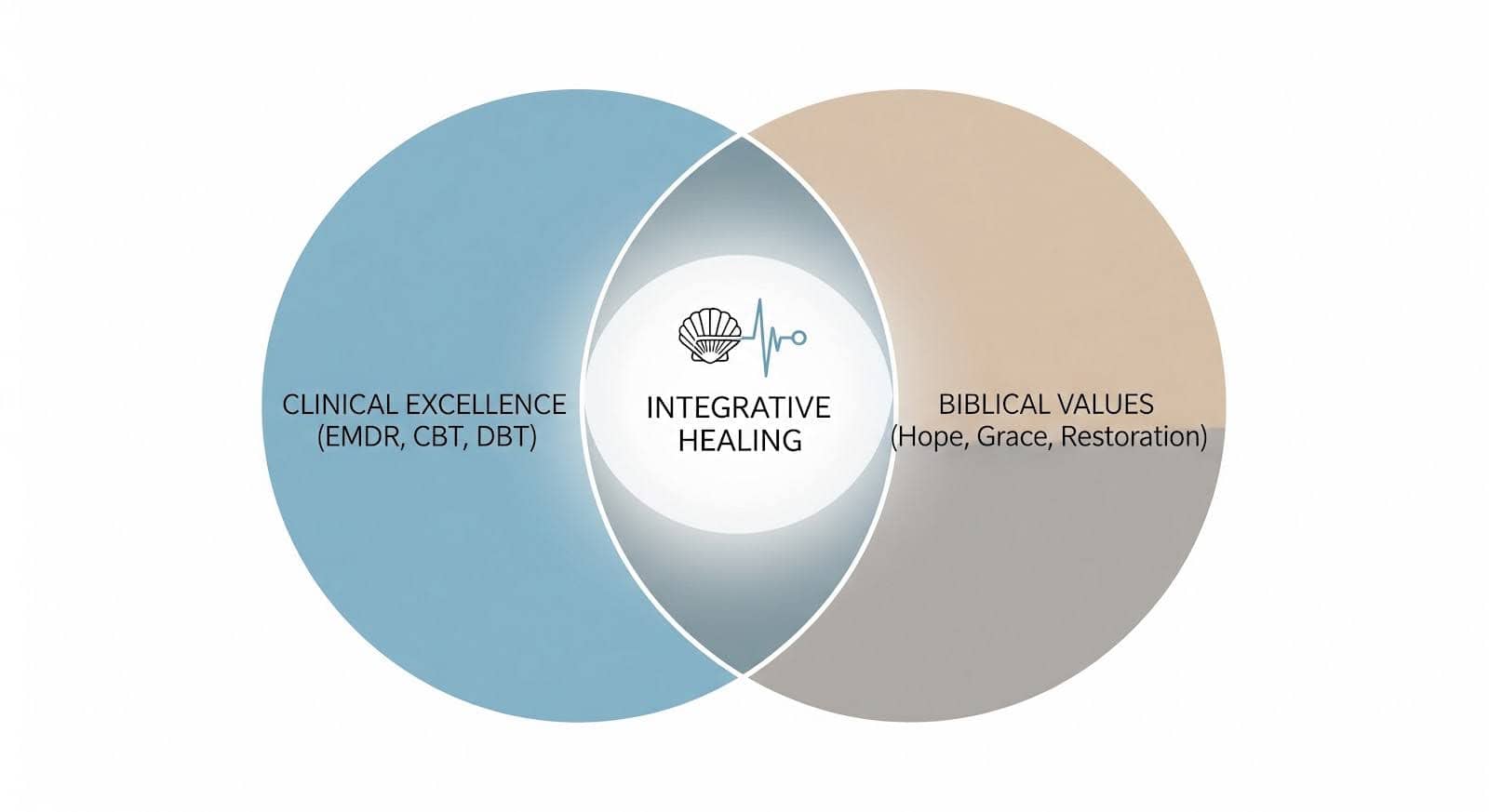
In our practice, we often see families who feel they must choose between professional clinical excellence and their deeply held faith. We believe you should never have to choose between rigorous clinical science and your spiritual values. Integrative Christian Counseling is a specialized approach that utilizes the “clinical engines” of modern psychology—such as Cognitive Behavioral Therapy (CBT) and EMDR therapy.
We anchor this entire process in a biblical narrative of hope and restoration. We don’t just talk about symptoms; we look at the soul of the family unit through:
- Clinical Precision: Using science-backed methods to address trauma and anxiety.
- Spiritual Alignment: Ensuring that the goals of therapy honor your family’s values.
- Attachment-Based Care: Focusing on the “relational currents” that connect parents and children through targeted family therapy.
Many families experience anxiety over personal issues. Read about Evidence-Based Psychotherapy for Anxiety: Which Methods Actually Work?
5 Signs Your Family is Ready for a ‘Safe Harbor’
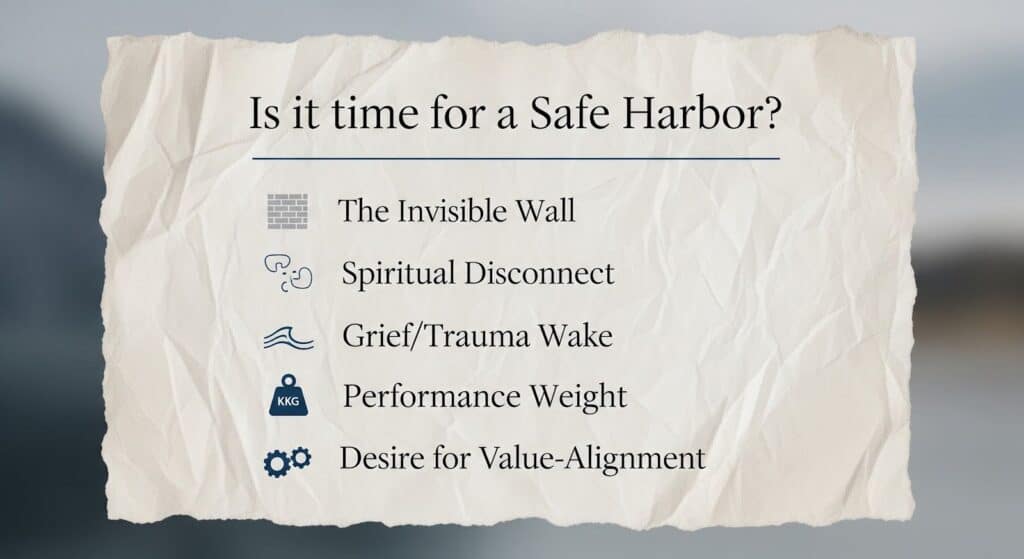
Recognizing when it is time to seek support is a sign of bravery, not failure. Our licensed Savannah counseling team identifies these five indicators as the most frequent signals that a family is ready for professional, faith-integrated care.
1. The “Invisible Wall”: Persistent Communication Breakdowns
Have you noticed that your family is talking more but saying less? When communication shifts from a bridge to a barrier, the relational current has been disrupted.
We often see this manifest as “negative loops” where every conversation ends in the same argument. In our clinical experience, dismantling this wall requires restoring the flow of genuine empathy through effective communication techniques.
2. Spiritual Isolation: Together in the Pew, Alone at Home
Spiritual isolation occurs when a family shares religious rituals but lacks emotional and spiritual connection at home. Christian counseling bridges this gap by providing a neutral space to align personal values with family interactions.
- The Symptom: Prayer feels forced or spiritual topics cause tension.
- The Opportunity: Moving from “performing” faith to experiencing it together as a source of comfort.
- The Navigator’s Perspective: We often find this is a symptom of unresolved emotional hurts blocking spiritual intimacy.
3. Navigating the Wake of Medical Trauma or Grief
Through our partnership with CURE Childhood Cancer, we have seen how a medical diagnosis changes the role of every family member. A serious diagnosis often disrupts the emotional balance of the entire household, according to the National Cancer Institute.
In these moments, the grief is collective. We provide the clinical expertise for managing grief and loss while using faith as a stabilizing anchor to ensure your family unit stays intact through the storm.
If your family is navigating the “heavy waters” of medical trauma, our Wilmington Island office provides a serene, trauma-informed environment for healing.
4. The Weight of High-Stakes Performance
Particularly in Savannah, we work with many families associated with SCAD student life. We help families shift from a “Performance-Based” identity to a “Grace-Based” identity when a child feels they must be perfect to be loved.
We use specialized counseling for children and teenagers to manage high expectations. This blends clinical mindfulness with spiritual grace to create a more resilient home environment.
5. A Shared Desire for Values-Aligned Healing
Christian counseling is a proactive choice for families seeking long-term resilience. By integrating clinical science with biblical principles, families can build a “relational sanctuary” that protects against future crises.
Choosing counseling in these moments isn’t about fixing what’s “broken.” It is about building the boat before the storm arrives to ensure individual growth and family restoration happen in tandem.
Read: The Clinical Integration of Faith and Psychology: A Professional Guide to Christian Counseling
Christian vs. Secular Counseling: Which Path is Right for Us?
Psychotherapy is most effective when there is a strong alliance based on shared goals, as noted by NAMI. For many, those goals are inextricably linked to their faith.
| Feature | Secular Counseling | Integrative Christian Counseling |
| Primary Goal | Symptom Reduction | Relational & Spiritual Restoration |
| Clinical Tools | CBT, DBT, EMDR | CBT, DBT, EMDR + Faith Integration |
| Source of Hope | Self-Actualization | Narrative of Redemption & Grace |
The First 50 Minutes: What to Expect
Our founder, Whitney Owens, LPC, envisioned a practice where the intake process feels like a conversation over coffee. We prioritize your comfort from the very first moment you connect with our team.
- Compassionate Matching: We pair your family with a clinician (LPC, LCSW, or MSW) who best fits your specific needs.
- Dropping Anchor: The first 50 minutes establish ground rules of safety, respect, and absolute confidentiality.
- The Discovery Phase: We listen to your story to identify the specific currents pulling your family off course.
Common Questions About Family Restoration (FAQ)
Does my teen have to be religious to participate?
No. We meet every family member exactly where they are. EMDR therapy, for instance, is a physiological process that works regardless of a person’s belief system.
Is Christian counseling more expensive?
No. We utilize a private-pay model to provide unhurried, personalized care. Learn more about our model here.
How long does it take?
Every journey is unique. Some find clarity in a few months, while others value a long-term partnership through different developmental stages.
Taking the Risk for Renewal
The “Water’s Edge” is a symbolic place to rest, but it is also a place to take a risk—to jump headfirst into a better life for your family. If you are ready to move toward peace, our team is here to walk alongside you.
The bravest thing you can do is take that first step.
Schedule Your First Appointment Today
Or Call Us Directly: 912-319-5552
About the Author
This article was written by the clinical team at Water’s Edge Counseling. As a boutique group practice with locations in Savannah and Wilmington Island, Georgia, our 17+ licensed clinicians are dedicated to providing high-resolution, evidence-based care that honors the unique story and clinical needs of every individual we serve.
Medical Disclaimer: The information provided on this website is for educational purposes only and is not intended as a substitute for professional medical advice, diagnosis, or treatment. Always seek the advice of your physician or other qualified health provider with any questions you may have regarding a medical or mental health condition. If you are experiencing a mental health emergency, please call 911 immediately or go to the nearest emergency room. If you are in crisis or having thoughts of suicide, please call or text the Suicide & Crisis Lifeline at 988.