


Have you ever felt like you had to leave your faith at the door when entering a therapist’s office? Or perhaps you’ve sought pastoral advice, only to realize your struggle with anxiety or trauma required a deeper clinical map?
At Waters Edge Counseling, we often see clients caught in this tension. You want the best of modern science, but you need a clinician who understands that your spiritual life isn’t just a hobby—it’s the foundation of your identity.
Healing isn’t about choosing between a faith and a therapy couch. It’s about finding the safe harbor where they meet, and we are here to walk that path with you.
The Bottom Line
Christian counseling is the professional integration of evidence-based psychological modalities (such as CBT, EFT, or the Gottman Method) with a faith based worldview. It differs from pastoral counseling by utilizing licensed clinicians (LPC, LCSW) to treat mental health disorders through a Biopsychosocial-Spiritual lens, ensuring clinical rigor remains aligned with spiritual values.
What is Christian Counseling? Defining the Professional Integration
Many people worry that “Christian Counseling” is just secular therapy with a few verses added at the end. In our practice, we define it as something much more robust: a partnership where clinical excellence and spiritual truth work in tandem.
In our Savannah and Wilmington Island offices, we treat the whole person. This means we don’t just look at your symptoms; we look at your narrative. We want to hear the “whole story” of who you are, without judgment or rush.
We believe that every person is created for connection. When that connection is broken—whether by life’s circumstances or mental health challenges—restoration requires a tailored approach through individual counseling that honors your deepest beliefs.
Read: 5 Signs Your Family Could Benefit from Christian Counseling: Navigating the Path to Restoration

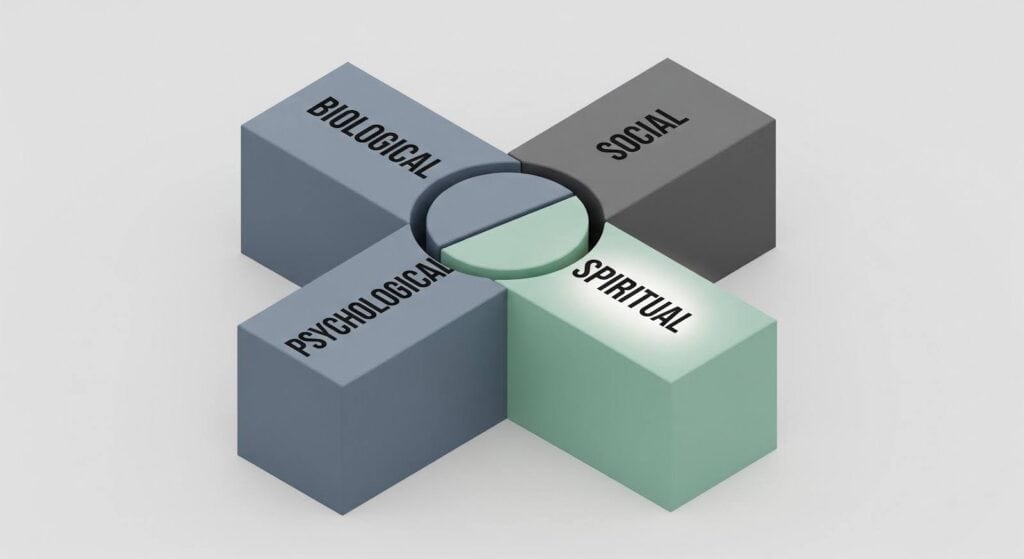
For decades, the secular world treated psychology and faith as separate entities. However, our clinical experience aligns with the Biopsychosocial-Spiritual (BPSS) Model, which is now the gold standard for holistic care.
This model acknowledges four vital pillars of health: biological, psychological, social, and spiritual.
- Biological: How your brain chemistry and physical health impact your mood.
- Psychological: How your thoughts, emotions, and coping behaviors take shape.
- Social: How your relationships and environment support (or strain) you.
- Spiritual: How your relationship with God and your sense of purpose anchor you.
When we ignore the spiritual pillar, the stool topples over. We often see high-functioning professionals whose “biological” burnout is actually colliding with a “spiritual” crisis of meaning. By addressing both, we find a path to resilience that therapy alone cannot provide.
Neuro-Theology: How Spiritual Practice Regulates the Nervous System
There is a beautiful, fascinating bridge between scripture and neuroscience. When we engage in spiritual disciplines like prayer or scripture meditation, we aren’t just “thinking positive thoughts.”
We are actively engaging in nervous system regulation through spiritual disciplines. Research in Polyvagal Theory—often cited by the American Psychological Association (APA)—shows that feelings of safety can be reinforced through faith.
When a client learns to sit in the presence of God during a session, they are retraining their amygdala to move from a state of “fight or flight” to a state of “rest and restoration.” It’s a physical physiological response to a spiritual truth.
Interested in how our specific team approaches this integration? Meet Our Faith-Based Clinicians
Beyond “Bible Verses”: How We Integrate Clinical Modalities
We don’t just “talk” about faith; we use it as a lens for the most effective clinical tools available today. Our clinicians choose these modalities because they offer the most direct path to relief for our clients.
- Restoring Marriages: We combine the Gottman Method with biblical principles of covenant and grace to move couples back to deep emotional intimacy.
- Processing Trauma: We use EMDR therapy to help you process painful memories while grounding you in the truth of your identity in Christ.
- Healing Children: We utilize Play Therapy to allow our youngest clients to express what they don’t have words for yet, within a framework that honors the family’s values.
If you are feeling stuck in a cycle of anxiety or relationship conflict, our team is ready to help you find your anchor in the storm.
Christian Counseling vs. Secular Therapy: Understanding the Differences
When clients ask us how our approach differs from secular offices, we point to the foundational “Why” behind the work. While both aim for symptom relief, the ultimate goal of Christian counseling is redemptive restoration.
| Feature | Secular Therapy | Christian Counseling (Waters Edge) |
| Foundational Truth | Subjective / Humanistic | Biblical Worldview |
| Primary Goal | Self-Actualization | Redemptive Restoration |
| View of Human Nature | Inherently Good or Neutral | Created for Connection; Fallen but Redeemed |
| Clinical Tools | Evidence-Based Modalities | Evidence-Based + Spiritual Integration |
Why Credentials Matter: Licensed Professionals (LPC/LCSW) vs. Lay Counseling
In the YMYL (Your Money, Your Life) space of mental health, your safety is our first priority. While talking to a pastor is wonderful for spiritual growth, it is not a substitute for clinical treatment.
Safety is paramount in mental health, which is why our team consists of licensed professionals governed by strict state boards. Our clinicians are governed by the Georgia Secretary of State Professional Licensing Boards.
Why this matters for your healing journey:
- Clinical Rigor: We are trained to treat complex mental health disorders with specialized tools.
- Ethics & Privacy: We adhere to strict state-mandated confidentiality—your story is safe with us.
- Accountability: Our licenses require ongoing education to ensure we are offering the best care possible.
The Waters Edge Approach: Your Story Deserves an Integrated Space
Choosing a therapist is one of the most personal decisions you will make. At Waters Edge Counseling, we’ve built our practice on the belief that you shouldn’t have to compartmentalize your life.
Our Savannah team brings decades of combined experience to ensure your clinical care is as deep as your faith. We offer a seasoned, compassionate perspective that honors your faith and respects your intellect.
Whether you are navigating the “waters” of infidelity, the fog of postpartum depression, or the weight of burnout, we are here to walk beside you.
Ready to begin your journey of integrated healing? Contact us to schedule a tailored intake today
FAQ: Common Questions About Faith-Integrated Mental Health
Do I have to be a “perfect” Christian to come to counseling?
Absolutely not. We meet you exactly where you are, whether your faith is flourishing or you are in a season of deep doubt and exhaustion.
How is this different from talking to my pastor?
Pastors provide spiritual guidance and community care. We provide clinical intervention for the physiological and psychological roots of your struggles. Think of us as specialized support for your mental health.
Do you take insurance?
We are a private-pay practice. This allows us to provide a higher level of privacy, responsiveness, and a “Tailored Care” model that isn’t restricted by insurance mandates. Learn more about our self-pay model here.
Take the Next Step: Integrated Care Starts Here
If you are ready for a professional, faith-integrated approach to mental health, our team of licensed clinicians is here to guide you.
Schedule Your Confidential Intake
Medical Disclaimer:
This article is for informational and educational purposes only and is not a substitute for professional medical or mental health advice, diagnosis, or treatment. The content provided is not intended to replace consultation with a licensed clinical professional (LPC, LCSW, LMFT, Psychiatrist) or your own pastor or spiritual advisor.
If you are experiencing a mental health crisis, please use the following resources immediately:
- Emergency Services: Call 911
- National Suicide & Crisis Lifeline: Call or text 988
- Go to the nearest emergency room.