


A teacher pulled you aside after pickup. Or the pediatrician mentioned it at the annual checkup. Or you’ve been watching your child struggle — with worry, with anger, with shutting down — and you’ve finally decided to do something about it.
Finding a child therapist in Savannah is one thing. Having the conversation with your child is another.
Most parents don’t lie awake wondering whether therapy will help. They lie awake wondering what to say. How do you explain it in a way a six-year-old can understand? What if your nine-year-old gets defensive? What if bringing it up makes things worse?
It usually doesn’t. And the conversation, even an imperfect one, is almost always better than silence. Here’s how to approach it in a way that actually works for children ages 5 through 12.
Start With What You’ve Noticed, Not With What Therapy Is
The instinct most parents have is to open with an explanation. “Therapy is when you talk to a special person who helps with feelings.” That’s not wrong, but it puts the child in the position of having to process a new concept before they understand why it’s relevant to them.
A more natural entry point is the specific thing you’ve observed. Before you say the word “therapy,” name what you’ve seen.
“I’ve noticed you’ve been having a really hard time at bedtime lately, and I want to help.”
“You’ve seemed really worried about school this year, more than usual. I’ve been thinking about ways I can support you.”
“I’ve noticed you’ve been getting frustrated really quickly, and it seems like something bigger might be going on.”
Children ages 5 through 12 are concrete thinkers. Abstract concepts like mental health, emotional regulation, and therapeutic intervention don’t land. What lands is: you see them, you’ve been paying attention, and you’re not upset with them about what you’ve noticed.
Start there. The explanation of therapy can come after.
How to Describe Therapy in a Way Kids Actually Understand
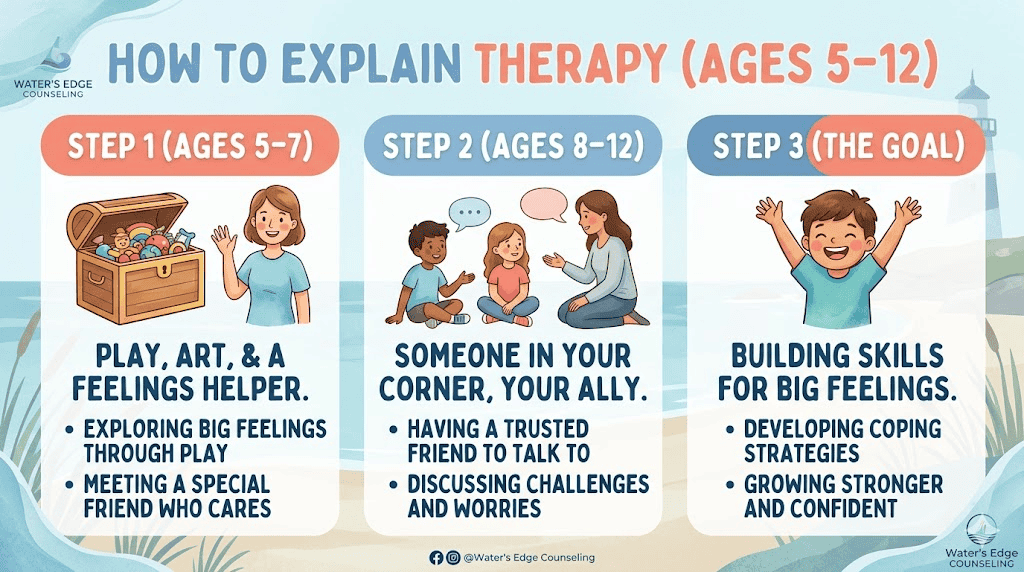
Once you’ve named what you’ve noticed, you can introduce the idea of a therapist in simple, specific terms. Tailor it to your child’s age.
For children ages 5–7:
Keep it concrete and reassuring. A therapist is someone who helps kids with big feelings, the same way a doctor helps with a hurt knee. You can call it “talking to a feelings helper” or “going to see someone who is really good at understanding kids.” Avoid words like “problem” or “disorder.” Frame it as something that happens because you love them, not because something is broken.
“We’re going to visit someone who helps kids when they’re feeling worried or upset. She knows a lot about feelings, and the two of you are going to play together and talk. It’s going to be pretty fun, actually.”
For children ages 8–12:
Older kids often have opinions about therapy already, shaped by what they’ve seen on TV or heard from friends. Meet them where they are. Acknowledge that therapy might sound weird or uncomfortable. Then reframe it as something many kids do, not something reserved for serious problems.
“I’ve set up some appointments with a counselor, someone you can talk to about what’s been going on. It’s not because you’re in trouble or because anything is seriously wrong. It’s because I want you to have someone in your corner besides me.”
The phrase “someone in your corner” tends to land well with this age group. It positions the therapist as an ally, not an authority figure there to examine them.
What to Do When Your Child Says No
Resistance is normal. Expect it, especially from children ages 8 and up. A flat “I don’t want to go” doesn’t mean therapy is the wrong call — it usually means the child is anxious about something unfamiliar, or doesn’t want to feel like something is wrong with them.
A few things that help:
Don’t negotiate the destination. Negotiate the details. “You don’t have to keep going if you truly hate it after a few sessions” is a very different statement from “Okay, we won’t go.” Giving a child an exit ramp after a fair trial is reasonable. Giving them veto power before they’ve ever walked in the door is not.
Give them control where you can. Let them choose what to wear. Let them bring a comfort item. Tell them they get to decide what they talk about — the therapist isn’t going to make them share anything they don’t want to. For children who feel powerless in the situation, having agency over the small details matters more than you’d expect.
Use the word “try.” Frame the first session as a single experiment, not a commitment. “Just try it once. If you hate it, we’ll talk.” Most children who walk through the door once are willing to go back.
For younger children (5–7): The word play therapy often disarms resistance entirely. When a child hears that therapy involves toys, sand trays, art, and games — not sitting in a chair and talking about their feelings — the picture changes. Describe it accurately, because accurate is more appealing than abstract.
What Therapy Actually Looks Like for Children Ages 5–12
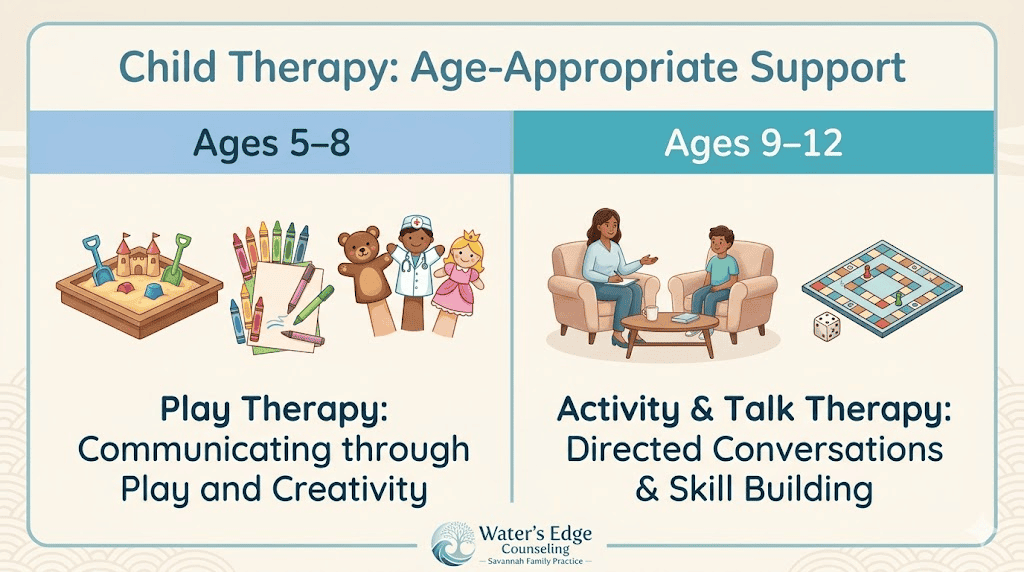
A lot of parental anxiety about this conversation comes from imagining that child therapy looks like adult therapy: a couch, a notepad, fifty minutes of processing emotions. For young children especially, it looks almost nothing like that.
For ages 5–8: Sessions often center on play, creative activity, and movement. A trained child therapist reads what a child communicates through how they play — the themes they return to, the way they respond to certain materials, what lights them up or shuts them down. The child doesn’t need to articulate their inner world in words. That’s the point of play therapy. They don’t have to be ready to “talk about it.”
For ages 9–12: Sessions become more conversational, but still child-directed. A good child therapist isn’t running through a list of questions. They follow the child’s lead, work with what the child brings, and build the relationship before anything else.
In both cases, parents are involved. Your child’s therapist will want to hear from you: what you’re seeing at home, what’s happening at school, what’s changed recently. You’re not dropped off at the waiting room and left out of the process. Especially in the early sessions, your perspective is part of the work.
The first session is almost always an intake. The therapist is getting to know your child and your family. Nothing is being “fixed” in session one, and that’s by design. Think of it as an introduction, not a treatment.
Progress shows up slowly and isn’t always visible at first. Behavioral changes that you can observe (fewer meltdowns, better sleep, more willingness to talk) often take eight to twelve sessions to surface. A child who seems unchanged after three or four appointments isn’t a sign that it isn’t working. The early sessions are about building trust, and that foundation is most of what makes everything else possible.
For a broader look at the child mental health landscape in Savannah, including what families typically encounter when they start the search, our piece on the state of child psychology in Savannah in 2026 walks through the full picture.
Questions Your Child Will Ask — and What to Say
Children have a short list of concerns they reliably bring up when therapy is introduced. Here’s the honest answer to each one.
“Am I in trouble?” No. Therapy isn’t a punishment. Tell them: “You’re not in trouble at all. This is something we do because I love you and I want to help you feel better — the same reason we go to the doctor when you’re sick.”
“Will you be in there with me?” At first, probably yes. Tell them: “Sometimes, especially at the beginning. And I’ll always know what’s happening. Your therapist and I talk so I can keep helping you at home too.”
“Do I have to tell them everything?” No. Tell them: “You get to decide what you share. Nobody is going to make you talk about anything you don’t want to.”
“Will kids at school find out?” No. Tell them: “What you talk about stays private. Nobody at school finds out. Not your teacher, not your friends. It’s just between you, your therapist, and our family.”
“Is something wrong with me?” This one matters most. Tell them: “Nothing is wrong with you. Lots of kids go to therapy: when they’re going through something hard, when their feelings get really big, when they just need someone to talk to. It’s actually a pretty brave thing to do.”
How to Keep the Conversation Going
The initial conversation is the hardest part. What comes after is easier, but it still requires some intention.
Don’t debrief your child immediately after the first session with a list of questions. Give them room to decompress. A quiet car ride home is fine. Let them bring it up if they want to.
Low-stakes openers work better than direct questions in the days that follow. “What did you think of her?” lands differently than “What did you talk about?” One invites, the other interrogates.
When you notice something shifting — a calmer morning, a better week, a moment where they handled something they usually can’t: name it without turning it into a report card. “You seemed a little lighter today” is enough.
If your child is struggling to connect with the therapist after a few sessions, raise it with the therapist directly rather than with your child. Fit matters. Changing providers is common and nothing to feel badly about. The goal is finding the right relationship, and sometimes that takes more than one try.
Above all: keep going to appointments, even when life gets busy. Consistency is most of what makes early therapy work. The relationship your child builds with their therapist is fragile at first and gets stronger over time — but only if they keep showing up.
Ready to Take the Next Step?
If someone in your child’s life has suggested therapy, that recommendation is worth following. At Water’s Edge Counseling, our therapists work with children across a range of concerns — anxiety, depression, behavioral challenges, grief, family transitions, and more. We’re a private pay practice, which means treatment is decided by your therapist and your family, not an insurance company. Sessions stay confidential, and the pace of care is set by what your child actually needs.
Learn more about our child counseling services in Savannah, or reach out to schedule a conversation with our team. We’re happy to answer questions before you book.
Frequently Asked Questions
How do I explain therapy to a 5-year-old?
Keep it simple and concrete. A therapist helps kids with big feelings, the same way a doctor helps with a hurt knee. You can use phrases like “feelings helper” or describe it as playing and talking with someone who is really good at understanding kids. Avoid clinical language and stay away from the word “problem.” The goal is to make it sound approachable and normal — because for a lot of kids, it is.
What if my child refuses to go to therapy?
Resistance is common and doesn’t mean therapy is the wrong call. Validate that it sounds unfamiliar or a little scary, without backing away from the decision. Give your child control over small details — what to wear, what to bring — while holding firm on going. Frame the first session as a single try. Many children who are resistant before session one are willing to go back after it. The play therapy model, in particular, often surprises younger children who expected something more serious.
Should I tell my child’s school they’re in therapy?
That’s entirely your decision. You’re not required to disclose that your child is in therapy to their school. At Water’s Edge Counseling, your child’s records are not shared with third parties without your explicit authorization. Some parents choose to loop in a trusted teacher or school counselor because coordination helps — but it’s always your call, not a requirement.
How long will my child need therapy?
Most families start to see meaningful shifts after eight to twelve sessions. Some children work through a specific stressor (a move, a loss, a difficult transition) and are ready to wrap up after a focused course of therapy. Others continue working with a therapist on an ongoing basis as they grow. Your child’s therapist will check in with you regularly about progress and next steps. You won’t be left guessing.
About the Clinical Reviewer
Katie Marklin, MA, CPCS is a counselor at Water’s Edge Counseling working toward licensure (LPC) in the state of Georgia under clinical supervision. She holds a Master of Arts in Clinical Mental Health Counseling from Northern Arizona University and a Bachelor of Arts in Communication from North Carolina State University. Katie works with adolescents, adults, and couples navigating anxiety, depression, relational struggles, life transitions, and eating disorder recovery. Her clinical approach draws from Cognitive Behavioral Therapy (CBT), Internal Family Systems (IFS), Acceptance and Commitment Therapy (ACT), and Dialectical Behavior Therapy (DBT). She is also trained in Level 1 of the Gottman Method. Katie sees clients at the Savannah office.
Water’s Edge Counseling provides individual, child, teen, and family therapy in Savannah, GA. To learn more about our child counseling services or schedule an appointment, contact our office at 912-319-5552.