


A teacher notices a student withdrawing. A pediatrician wraps up an annual visit and the parent mentions their child hasn’t been sleeping, hasn’t been eating, hasn’t been the same since last fall. A school counselor flags a pattern of absences that started around the same time as a family crisis.
In all three cases, the next step is the same: find a child therapist.
In Savannah, as in much of Georgia and the country, that next step is far harder than it should be.
This is not a story about awareness. Most providers and educators in 2026 already know that child mental health matters. This is a story about access — what happens after a child is identified as struggling and someone tries to get them help. The system they encounter is strained at nearly every point: not enough providers, insurance that promises more than it delivers, and waiting lists that stretch for months.
Understanding where those pressure points are is the first step toward working through them. That’s what this article is for.
What the Numbers Say About Child Mental Health Access in 2026
The demand for child mental health services has been rising for years. The supply has not kept up.
According to the American Psychological Association, only an estimated 15% of children who need mental health services actually receive appropriate help. That figure should be alarming. The vast majority of kids who could benefit from therapy never make it through the door.
Part of the reason is a workforce problem. As of December 2025, roughly 137 million Americans — about 40% of the population — live in a federally designated Mental Health Professional Shortage Area, according to the Health Resources and Services Administration. Shortage designations don’t just describe rural counties. Many suburban and urban communities are included, because the ratio of providers to population simply doesn’t meet federal minimums.
Child and adolescent specialties are hit hardest. The American Academy of Child and Adolescent Psychiatry reports that 72% of U.S. counties have no practicing child and adolescent psychiatrists at all, with a national average of only 15 per 100,000 children.
The gap is widening, not closing. Federal projections put demand for mental health services at a 49% increase by 2033, while the behavioral health workforce is expected to grow by just 11% over the same period. For anyone trying to refer a child into care today, those numbers explain a lot about why the phone calls aren’t being returned.
The Situation in Georgia — and Why Savannah Feels It
Georgia’s numbers have improved in some measures. Mental Health America’s 2025 State of Mental Health in America report placed Georgia 13th out of 51 states for youth mental health, which reflects better-than-average access compared to most of the country. Worth noting.
For families in Savannah trying to find a child therapist today, though, a favorable ranking doesn’t open up appointments.
The Georgia Mental Health Access in Pediatrics program (GMAP), operated through the Georgia Health Policy Center, has documented an average wait time of six to eight months for adolescents referred to a behavioral health specialist in Georgia. Six to eight months. For a teenager already in distress, that timeline can mean an entire school year passes before they see a clinician.
Pediatric primary care providers across the state report difficulty finding therapists for their patients. Not from a lack of trying — the referral network is genuinely stretched thin.
Chatham County carries an additional layer of pressure. Savannah functions as a behavioral health hub for coastal Georgia, with Gateway Community Service Board serving families from Effingham County south to Glynn County and beyond. Gateway has explicitly cited a significant shortage of child and adolescent psychiatrists as one of its primary institutional challenges, enough so that it launched its own child psychiatry fellowship program to build the local pipeline from scratch. Worth noting: the vast majority of children seeking outpatient mental health support don’t need a psychiatrist to start. What they need is a licensed therapist — and that’s precisely where the access gap is most urgent and most solvable.
Two recent investments are worth knowing about. In late 2024, Chatham County and Gateway broke ground on a new Child and Adolescent Mental Health Campus at 7 West Magnolia Drive. In April 2025, Savannah-Chatham County Public Schools launched a partnership with Hazel Health to provide free virtual mental health services to district students. Both are serious commitments. Both are also evidence of how significant the unmet need still is.
The Three Barriers Families Keep Running Into
When a teacher or pediatrician refers a family to a child therapist, they often think the hard part is done. In our experience working with Savannah families, the referral is usually where the hard part begins. These are the three barriers that come up most often.
1. The Waitlist Problem
Private outpatient child therapists in Georgia are routinely booked weeks to months out for new pediatric clients. That’s true even for practices actively trying to grow.
What makes it worse is the “ghost network” effect. Insurance directories list providers as accepting new patients who aren’t. Or whose earliest opening is five months away. Or who technically accept the insurance but have stopped taking new referrals. Families spend weeks making calls that go nowhere, and by the time they’ve hit the fifth voicemail, some give up entirely.
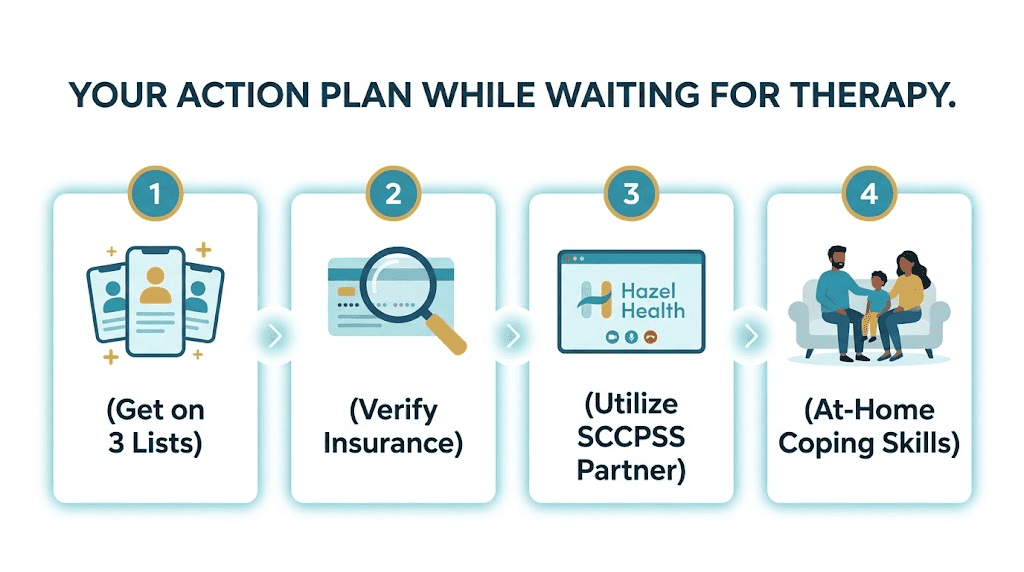
The most useful thing a provider or educator can do is give families multiple names at once, not one. Three or four referrals improves the odds that at least one call leads somewhere. Set expectations honestly: finding availability will take effort, and that persistence is worth it. If a child is showing signs of behavioral escalation in the meantime, our post on brea-king down escalation cycles has practical guidance for those moments while a family waits.
2. The Insurance Maze
Federal mental health parity laws require insurance plans to cover mental health services at the same level as physical health care. The law is sound. Enforcement is inconsistent, and what Georgia families actually encounter is often something else.
Prior authorization requirements pile delays on top of already long waitlists. Co-pays can be higher than families expect. Many families discover, after calling a dozen providers, that their plan covers child therapy in theory — but no in-network therapist within a reasonable distance is actually taking new patients.
What providers can do: help families understand that private pay therapy isn’t just a workaround for insurance gaps — for many families, it’s a deliberate and clinically sound choice. At Water’s Edge Counseling, being a private pay practice means no third party reviews session notes, no insurer dictating how many sessions a child gets, and no pressure to assign a more severe diagnosis than warranted just to justify coverage. Treatment is decided by the therapist and the family, not a billing department. For families with out-of-network benefits, a superbill can be submitted for partial reimbursement, which makes private pay more accessible than many assume. Our post on why families in Savannah choose private pay therapy explains the full picture.
It’s also worth pointing families toward Georgians for a Healthy Future’s Georgia Mental Health Parity Dashboard, which tracks insurance compliance and helps families push back when a claim is denied.
3. Knowing Who to Call and When
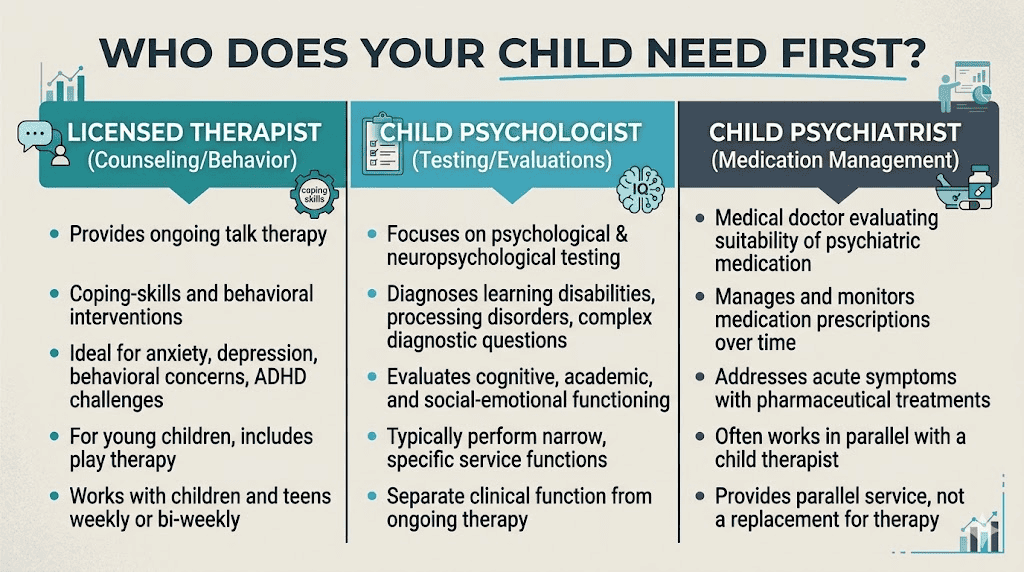
Many referrals stall because the person making them — a teacher, a pediatrician, a school counselor — isn’t sure which type of provider the child actually needs. That confusion causes real delays. We’ve written a full breakdown of child vs. adolescent counseling that can help clarify where to start.
Here’s the short version:
A licensed therapist or counselor provides talk therapy, coping-skills work, and behavioral interventions in regular weekly or biweekly sessions. This is where most children with anxiety, depression, behavioral concerns, ADHD-related challenges, or family stress should begin — and for the majority, it’s where the most meaningful work happens. For younger children, play therapy is often the better fit — it works at a child’s developmental level rather than expecting adult-style conversation.
A child psychologist holds a doctoral degree and specializes in formal psychological and neuropsychological testing — evaluations for learning disabilities, processing disorders, or complex diagnostic questions. This is a narrow, specific service. It is not a more advanced version of ongoing therapy; it is a separate clinical function. A licensed therapist can support a child with ADHD, anxiety, or behavioral concerns without a psychologist’s involvement.
A child and adolescent psychiatrist is a medical doctor who evaluates whether psychiatric medication is appropriate and manages prescriptions over time. If a child’s treatment plan includes medication, a therapist and a prescribing provider work in tandem — the therapist remains the ongoing therapeutic relationship. Medication management is a parallel service, not a replacement for therapy or a reason to leave a therapist who is a good fit.
The most common referral mistake is sending a child to a psychiatrist when what they need first is a therapist — then waiting six to eight months for a psychiatric evaluation when a licensed counselor with availability could have started the real work months earlier.
Start with a licensed therapist. If formal testing or medication becomes part of the picture down the road, those services can be added alongside ongoing therapy, not instead of it.
What Referring Providers and Educators Can Do Right Now
The barriers are real. So are the practical workarounds. These are the steps that move the needle.
Refer early. The waitlist doesn’t get shorter by waiting. If a child is showing early signs of anxiety, withdrawal, depression, or significant behavioral changes, start the referral now — before things escalate. A family that starts making calls in October has a much better shot at getting their child seen before the new year than one that waits for a crisis. For educators unsure whether a pattern warrants a referral, our piece on addressing behavioral issues through child therapy may help with that call.
Give multiple names. A single referral sets families up for a dead end when that provider isn’t available. Three or four names gives the search somewhere to go.
Be direct about the process. Families sometimes read a series of unanswered calls as a sign their child’s situation isn’t serious enough, or that they’re asking wrong. Tell them plainly: this is a system problem, not a reflection of their child. That framing keeps families in the search rather than dropping out.
Know your local options. Child counseling and teen counseling through private practices like Water’s Edge Counseling is one entry point. Gateway Community Service Board uses a sliding-scale fee structure and serves families regardless of insurance status. SCCPSS students can access free virtual services through Hazel Health. Which option fits depends on the family’s insurance situation, the child’s age, and the level of care needed. For families unsure what’s driving a child’s struggles, our posts on navigating teenage peer pressure and the impact of social media on teen mental health offer useful context.
What to Expect When a Child Starts Therapy
One of the main reasons families drop off after the referral: they don’t know what they’re walking into. When a provider or educator sets accurate expectations upfront, families are more likely to follow through and stick with it long enough for it to work. If you’re a school counselor, our piece on a day in the life of a school counselor speaks directly to the role you play in that handoff.
Here’s what the early stages of child therapy typically look like.
The first session is almost always an intake. The therapist is gathering history, learning about the child and family, and starting to understand what brought them in. Nothing is being “fixed” yet. That’s not a slow start — it’s how the work is supposed to begin.
Parents are usually involved in early sessions, especially with younger children. As trust builds, the child may begin seeing the therapist independently.
Progress isn’t linear and doesn’t always look like progress for a while. Behavioral changes that parents and teachers can actually observe often take eight to twelve sessions to surface. A child who seems unchanged after four sessions isn’t evidence that therapy isn’t working.
Therapist fit matters. If a child doesn’t connect with the first clinician they see, that’s useful information, not failure. Trying a different provider is appropriate and common. The relationship is a significant part of what makes the work effective.
In our work with children and teens at Water’s Edge Counseling, the first month is usually about one thing: building trust. That isn’t a warm-up. It’s the foundation everything else is built on.
Looking Ahead: What 2026 Means for Child Psychology in Savannah
The picture is complicated. The need is real and growing. The workforce is stretched. The barriers are documented.
The responses are beginning to catch up — but slowly, and from behind.
The new Gateway Child and Adolescent Mental Health Campus on West Magnolia Drive will expand public-sector capacity in a region that has served as the behavioral health hub for coastal Georgia. The SCCPSS and Hazel Health partnership is reaching students who had no other path to care. GMAP is helping Georgia pediatricians feel better equipped to screen, assess, and refer.
For children in Savannah who need outpatient therapy right now, private practices remain the most practical point of entry. The gap between demand and supply hasn’t closed. Referrals that are specific, warm, and persistent still make the difference between a child who gets help and one who doesn’t.
If you’re a teacher, school counselor, or pediatric provider in the Savannah area and a child in your care needs support, we’re here. Learn more about our counseling team or reach out to schedule a conversation about whether Water’s Edge is a good fit.
Frequently Asked Questions About Child Psychology in Savannah
How long is the wait to see a child therapist in Savannah, GA?
Wait times vary by provider, but families should expect anywhere from a few weeks to several months depending on availability. Georgia’s statewide average for adolescents referred to a behavioral health specialist is six to eight months, according to the Georgia Health Policy Center. That figure reflects psychiatric specialist referrals specifically — licensed therapists and counselors in private practice typically have considerably shorter wait times and are the right starting point for most children. Starting the search with a licensed therapist as early as possible is the single most important factor in getting a child seen in a reasonable timeframe.
What is the difference between a child therapist, a child psychologist, and a child psychiatrist?
A licensed child therapist or counselor provides ongoing talk therapy and behavioral intervention — working through anxiety, depression, behavioral challenges, family stress, trauma, grief, and more. For most children, this is the primary and complete therapeutic relationship. A child psychologist holds a doctoral degree and performs formal psychological and neuropsychological testing, which is a specific service for complex diagnostic evaluations — not a more advanced form of ongoing therapy. A child psychiatrist is a medical doctor who evaluates whether psychiatric medication is appropriate and manages it over time. If medication becomes part of a child’s care, the therapist and prescribing provider work in parallel — the therapist doesn’t step aside. Most children with anxiety, depression, or behavioral concerns need a licensed therapist. That’s the right starting point, and for the majority of kids, it’s where the most meaningful work happens.
Does insurance cover child therapy in Georgia?
Under federal mental health parity laws, most insurance plans are required to cover mental health services at the same level as physical health care. In practice, enforcement gaps and prior authorization requirements create real barriers even for insured families. Many Savannah families find that no in-network child therapist within a reasonable distance is taking new patients. Some families respond to that reality by looking at private pay practices — and find that stepping outside the insurance system comes with real advantages: greater privacy, no insurer reviewing session notes or dictating a diagnosis, no session limits, and treatment that’s driven by the therapist and family rather than a billing department. For families with out-of-network benefits, a superbill can offset a meaningful portion of the cost. It’s not a niche option — it’s how a growing number of Savannah families are choosing to access care.
How do I refer a student or child patient to a therapist in Savannah?
The most effective referrals include three or four provider names, a brief note on what to expect during the intake process, and encouragement to start calling now rather than waiting. Water’s Edge Counseling provides child counseling and teen counseling services and can be contacted directly to check availability. For families without insurance or with limited resources, Gateway Community Service Board operates on a sliding-scale fee structure in Chatham County.
At what age can a child start therapy?
Children can begin therapy at virtually any age. The approach changes significantly by developmental stage — play therapy and parent-involved sessions work well for younger children between ages three and seven, while structured talk therapy becomes more effective through middle childhood and adolescence. The right age to start isn’t a number. It’s whenever a parent, teacher, or pediatrician first notices something worth paying attention to. Waiting for a crisis is almost never the right call.
About Hunter: Hunter Bickers is a Licensed Professional Counselor (LPC) and Certified Master Addiction Counselor (CMAC) at Water’s Edge Counseling. With a clinical focus on adolescents and adults, Hunter brings extensive experience in treating anxiety, depression, and trauma. His practice is grounded in a combination of cognitive-behavioral, person-centered, and solution-focused therapies, helping clients identify their own internal resources to overcome obstacles. Hunter is dedicated to improving mental health access for the coastal Georgia community and specializes in supporting families through life transitions and behavioral health challenges.
Water’s Edge Counseling provides individual, child, teen, and family therapy in Savannah, GA. Our team works with children and adolescents across a range of concerns, including anxiety, depression, behavioral challenges, grief, and family transitions. To learn more or schedule an appointment, contact our office at 912-319-5552.