


You’ve done the reading. You know what EMDR is — the bilateral stimulation, the eight phases, the way it targets memory at the root rather than talking around it. Maybe you’ve already tried it. Maybe you’ve spent years in therapy and something still won’t shift. Maybe what you’re carrying doesn’t fit into a single event you can point to and say, that’s where it started.
Complex trauma is like that. It doesn’t always have a clear beginning. It accumulates — across years, across relationships, across experiences that individually might seem manageable but together have left a mark that standard approaches don’t always reach.
This guide is for that person. It covers the advanced EMDR applications used at Waters Edge Counseling in Savannah for clients working through layered, complex, or treatment-resistant trauma: what those approaches look like in practice, who they fit best, and what to expect when the work goes deeper.
This article is for informational purposes only and does not constitute clinical advice, diagnosis, or treatment. Please consult a licensed mental health professional to determine what care is appropriate for your individual situation.
Standard vs. Advanced EMDR: What’s the Difference?
Standard EMDR was built for discrete traumatic events. A car accident. An assault. One thing that happened and lodged itself, refusing to file away like ordinary memory does. The therapist and client identify a specific target, process it through bilateral stimulation, and work toward resolution. For single-incident trauma, this protocol is often efficient and genuinely effective.
Advanced EMDR applications address a different clinical picture. When trauma is complex — meaning it developed over time, repeated itself, or is rooted in early attachment disruption — there is rarely a single memory to target. What exists instead is a network: interconnected memories, negative beliefs, body sensations, and emotional patterns that formed together and reinforce each other. Processing one node without addressing the roots often brings temporary relief, then the same distress resurfaces in a different form.
Advanced EMDR accounts for that complexity. It moves more deliberately, invests more time in stabilization before any processing begins, and integrates additional techniques alongside the standard protocol. The destination is the same — reducing the emotional charge of traumatic material so it stops running in the background of daily life. The path there is more careful.
The standard eight-phase EMDR protocol stays the clinical foundation throughout. What changes is how it’s adapted and sequenced for clients whose trauma requires more precision.
Advanced EMDR Techniques Used in Trauma Recovery
Resource Development and Installation (RDI)
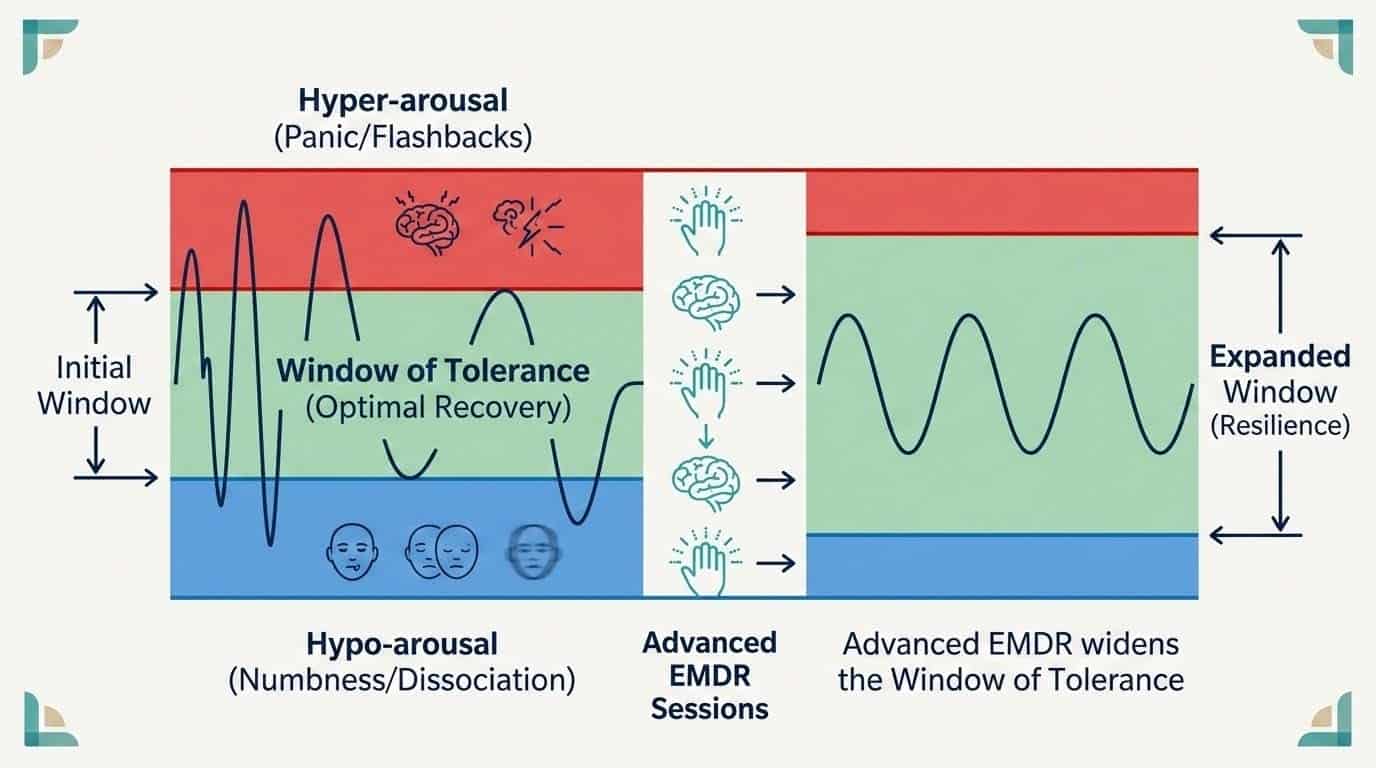
Before any trauma processing can begin, a client needs internal resources — some stable psychological ground to work from. For clients with complex or developmental trauma, that ground often isn’t solid enough yet. It needs to be built.
Resource Development and Installation (RDI) is an extended preparation phase focused entirely on constructing those internal anchors. A therapist might help a client develop a “safe place” — an internal image or sensation connected to calm — then use bilateral stimulation to strengthen and install it, making it more accessible when stress hits. Other resources might include a nurturing inner figure, a felt sense of competence, or a specific memory of handling something hard.
These aren’t relaxation exercises. They’re structured clinical interventions, each reinforced through bilateral stimulation, designed to expand what clinicians call the “window of tolerance” — the zone where a person can engage with difficult material without becoming flooded or going numb. For clients whose nervous systems have been shaped by years of chronic stress or early relational harm, this phase takes longer than expected. That isn’t a delay in treatment. It is the treatment.
Targeting Trauma Networks, Not Just Memories
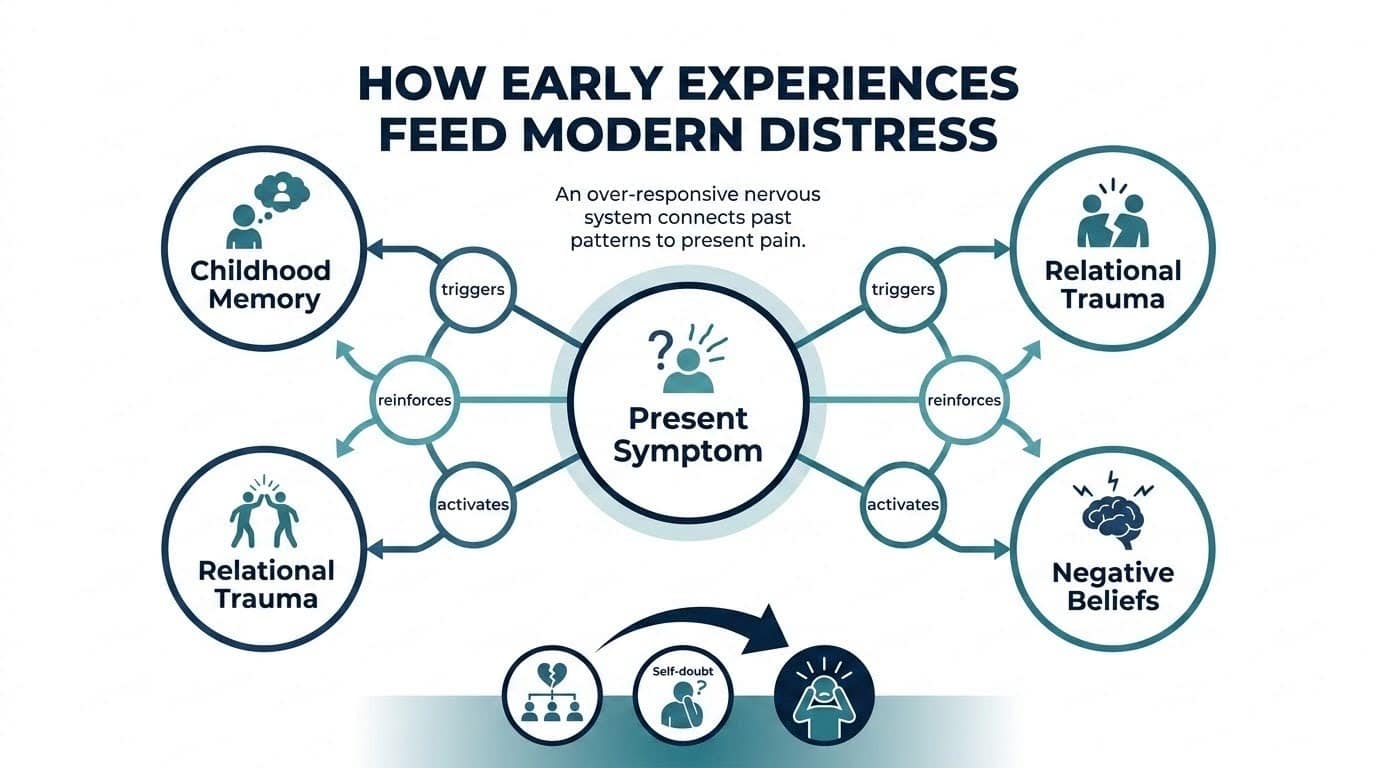
Individual traumatic memories don’t operate in isolation. They’re connected — by similar emotions, shared negative beliefs (“I’m not safe,” “I’m worthless,” “nothing I do matters”), and physical sensations that recur across different situations and years. Clinicians working with advanced EMDR call these clusters trauma networks.
Mapping a client’s network before processing begins helps the therapist identify what EMDR practitioners call “feeder memories” — earlier experiences that are supplying the emotional charge behind more recent, surface-level distress. This matters because treating only the presenting symptom while leaving the root untouched is why trauma sometimes returns after apparently successful treatment.
An advanced EMDR therapist uses the history-taking phase to understand not just what happened, but how those experiences connect — what beliefs they created, what the body still holds, how they continue to shape present-day functioning. Processing then follows a deliberate sequence, often working through earlier material before addressing more recent trauma. The science behind how EMDR reprocesses memory explains why this sequencing matters neurologically, not just clinically.
Bilateral Stimulation Variations
Most people picture EMDR as following a therapist’s fingers left to right. Eye movements are the original method and the most studied, but they’re not the only option — and for some clients, they’re not the right one.
Tactile bilateral stimulation (alternating taps on the knees or hands) can work better for clients who struggle to track visually or who find eye movements activating rather than settling. Auditory tones delivered through headphones, alternating left and right, are another option. Clinicians trained in advanced EMDR calibrate which modality serves each client, then adjust the speed, duration, and intensity of stimulation sets based on how that person’s nervous system actually responds.
For complex trauma, slower and shorter sets often produce better results than the longer, faster sets used in standard protocol. The goal isn’t to push through material — it’s to stay inside the window of tolerance while maintaining forward movement. The therapist is reading the client’s responses throughout and adjusting in real time.
EMDR and Parts Work
Clients with complex or developmental trauma sometimes encounter something unexpected during processing: different “parts” of themselves respond to the same memory in conflicting ways. One part wants to let it go. Another part doesn’t feel safe enough to. One part remembers the event as overwhelming; another has kept it compartmentalized for years and isn’t ready to release it.
This isn’t a complication. It reflects how the mind organizes itself under sustained stress. Research on dissociation and structural dissociation of the personality — developed by clinicians including van der Hart, Nijenhuis, and Steele — describes how traumatic experience can fragment into separate self-states that each carry part of the memory.
Advanced EMDR clinicians who also draw on ego state therapy or parts-based frameworks can work with those different aspects directly, rather than trying to push past them. At Waters Edge, clinicians like Gabriella Lehmkuhle integrate psychodynamic and parts-aware approaches with trauma-focused work — meeting each client where their internal experience actually is, not where the protocol assumes it should be. For clients dealing with dissociative symptoms, the practice also has a resource page on the many faces of dissociation that can help frame what they’re noticing.
Who Benefits Most from Advanced EMDR?
The clients who tend to get the most from advanced EMDR are those for whom standard approaches have hit a ceiling — or whose history suggests they would reach that ceiling quickly.
Complex PTSD and developmental trauma. When trauma began early, often within primary attachment relationships, it shapes not just specific memories but the underlying architecture of how a person sees themselves and others. The American Psychological Association recognizes EMDR as an effective treatment for PTSD, and growing clinical literature supports its use in complex presentations. Advanced EMDR addresses this at depth — not just at the level of individual incidents.
Relational and attachment trauma. Infidelity, chronic emotional neglect, abandonment, years of unpredictable caregiving — these create a kind of ambient trauma that doesn’t map to a single event. For clients dealing with the aftermath of relational harm, resources like unpacking trauma: a journey towards healing can offer context alongside clinical work.
Military veterans and first responders. Savannah has a substantial military community, and the trauma carried by veterans often involves both combat exposure and moral injury — the weight of decisions made in impossible situations. This kind of trauma can be deeply layered and requires extended stabilization before processing is appropriate. Waters Edge’s military counseling team works specifically with this population. The U.S. Department of Veterans Affairs lists EMDR as a strongly recommended treatment for PTSD in veterans.
Clients who have plateaued. Some people have done real work in therapy — built insight, developed coping strategies, understood their history — but the emotional charge still hasn’t resolved. Individual counseling lays essential groundwork; EMDR often reaches what insight alone cannot.
Women with trauma histories. Research on women and post-traumatic stress disorder shows women are diagnosed with PTSD at roughly twice the rate of men, often following interpersonal trauma — a population where complex, relational presentations are particularly common.
Survivors of chronic or repeated trauma. A single incident is traumatic. Years of emotional abuse, domestic violence, or childhood neglect create something different — a nervous system shaped by ongoing threat. Advanced EMDR addresses that systemic impact, not just individual events.
If you’re wondering whether your history is “complex enough” to warrant this approach, that question is worth raising with a therapist. What matters isn’t how your experiences appear from the outside. It’s whether something from the past is still shaping how you feel, think, or function today.
What to Expect When the Work Goes Deeper
If standard EMDR already sounds intense, deeper work might sound worse. In practice, it’s often the opposite.
Advanced EMDR with complex trauma moves more slowly, not faster. More time in stabilization. More sessions before processing begins. More check-ins throughout. The therapist’s job is to keep you inside a range where you can engage with difficult material without being overwhelmed — not to push you through it.
Progress doesn’t always look dramatic in the moment. Sometimes it’s quieter than expected: a memory that once felt urgent begins to feel more distant. A body tension that appeared whenever a topic came up starts to ease. Old beliefs that ran like background noise start to lose their authority. A 2013 meta-analysis in the Journal of Anxiety Disorders found EMDR effective across a range of trauma-related presentations — the research base reflects what clinicians observe: change is real, but it unfolds on the nervous system’s timeline, not the calendar’s.
Clients working on complex trauma should expect a longer treatment arc. How long depends on the scope of the history, how developed a client’s stabilization resources are, and how the nervous system responds to processing. No honest assessment can give you a precise session count before that work has begun.
What you can expect at Waters Edge is that pacing decisions are made with you, not imposed on you. The first session and often several sessions beyond it are dedicated entirely to history, rapport, and building the stabilization foundation — before bilateral stimulation starts.
The EMDR and Trauma Team at Waters Edge Counseling
The depth of an EMDR clinician’s training shapes everything about how the work unfolds — how they assess readiness, how they pace, how they respond when a session surfaces something unexpected. Here are the clinicians at Waters Edge with specific EMDR and trauma expertise.
Whitney Owens, LPC — Practice Founder
Whitney Owens founded Waters Edge Counseling in 2014 and has practiced as a licensed therapist in Georgia since 2009. She holds a Master in Professional Counseling from Richmont Graduate University and is a member of the American Counseling Association. Her clinical background spans residential treatment, inpatient settings, and private practice, with specializations in trauma, anxiety, and identity. Trained in both EMDR and IFS, Whitney’s work integrates both frameworks — which is particularly suited to the complex, parts-aware trauma work described in this article.
Abbie Roy, LCSW — EMDR Specialist
Abbie Roy is Waters Edge’s dedicated EMDR specialist, with extensive training in EMDR for clients ages six and up. Born and raised in Savannah, she brings both clinical depth and genuine community knowledge to her work. Abbie builds individualized treatment plans drawing on EMDR, CBT, and Solution-Focused approaches — calibrated to what each client’s history and goals actually call for. For clients whose primary goal is focused EMDR trauma work, she is the most direct clinical match on the team.
Gabriella Lehmkuhle, LMSW — Trauma and Parts Work
Gabriella Lehmkuhle holds a Master of Social Work from the University of Tennessee, where she specialized in clinical psychotherapy and trauma. She is trained in Brainspotting, Trauma-Focused CBT, Acceptance and Commitment Therapy, Dialectical Behavior Therapy, and Psychodynamic Therapy. That breadth reflects a working knowledge of how trauma presents differently across clients. For clients where EMDR processing surfaces complex internal dynamics, or where a parts-aware lens is indicated, Gabriella has the tools to work in that territory carefully.
To find out which clinician fits your specific history and goals, our Client Care team will ask the right questions when you reach out to schedule. You can also learn more about the full team at our Georgia counseling team page.
Frequently Asked Questions
How is advanced EMDR different from standard EMDR?
Standard EMDR targets discrete, identifiable traumatic events and follows the eight-phase protocol in a relatively direct sequence. Advanced EMDR applies that same protocol to complex, layered, or developmental trauma — where there is no single memory to target, the nervous system requires more preparation, and processing must account for interconnected trauma networks rather than individual incidents. The techniques (resource development, network mapping, bilateral stimulation variations, parts-aware approaches) extend the core protocol; they don’t replace it.
How many EMDR sessions does complex trauma recovery take?
There is no honest universal answer. Single-incident trauma may resolve in fewer than ten sessions. Complex or developmental trauma typically requires a longer arc — often months, including an extended stabilization phase before any processing begins. A thorough early assessment is the only sound basis for any timeline estimate. Clinicians who quote a session count before understanding your history are giving you a number, not a clinical judgment.
Can EMDR make trauma worse if my history is complicated?
When conducted by a properly trained clinician with adequate stabilization and careful pacing, EMDR does not worsen trauma. The risk of retraumatization is addressed directly by the protocol’s structure — Phases 1 and 2 establish stabilization and assess readiness before processing begins. For complex trauma clients, those phases are extended as long as necessary. If a session becomes too intense, trained EMDR therapists have specific containment strategies to close safely. The EMDR International Association (EMDRIA) sets the training and practice standards that govern this.
Is EMDR covered by insurance at Waters Edge Counseling?
Waters Edge is a private-pay practice. Sessions are not billed directly to insurance, though the practice can provide documentation for clients pursuing out-of-network reimbursement. Session rates run $90–$140. For more on how private-pay therapy works and why Waters Edge operates this way, see the private pay vs. insurance guide. For fee questions, contact the practice directly at 912-319-5552.
Ready to Go Deeper?
Complex trauma doesn’t respond well to approaches built for simpler presentations. It responds to a clinical relationship built on trust, a therapist with the right training, and a pace that respects how healing actually works in the nervous system.
If you’ve been wondering whether advanced EMDR might reach what other approaches haven’t — or whether your history calls for something more patient and layered — that’s worth exploring with someone who can assess it properly.
Waters Edge Counseling has been part of the Savannah community since 2014. EMDR-trained clinicians see clients in person at our downtown Savannah office on E Bolton Street and at our Wilmington Island location, and provide secure telehealth for clients across Georgia.
When you’re ready: contact our Client Care team or schedule online. We’ll match you with the right clinician and get you in — typically within one to two weeks.
About This Article
This article was written and published by Water’s Edge Counseling, a licensed mental health practice serving Savannah, Wilmington Island, and clients across Georgia via secure telehealth. Founded in 2014 by Whitney Owens, LPC, the practice has grown from a single-clinician office on Bull Street to a 17-clinician, three-location practice specializing in trauma, anxiety, couples counseling, and more.
Clinical review was provided by Whitney Owens, LPC, practice founder and licensed professional counselor in Georgia since 2009. Whitney holds a Master in Professional Counseling from Richmont Graduate University, is a member of the American Counseling Association, and is trained in EMDR and Internal Family Systems (IFS). Her background includes residential treatment, inpatient settings, and over a decade of private practice focused on trauma and complex presentations.
For a full overview of the Waters Edge clinical team and their individual specialties, visit the Georgia counseling team page.
Water’s Edge Counseling · 420 E Bolton St Savannah, GA 31401· 912-319-5552 · watersedgecounseling.com