


It probably doesn’t feel like a disorder. It feels like discipline. Or control. Or just being careful about what you eat in a new environment where nobody is watching.
Maybe you’ve been skipping dinner a few nights a week and telling yourself it’s fine. Maybe you eat until you feel sick and then hate yourself for it. Maybe the rules you have around food (what’s allowed, what isn’t, how much you can have before you’ve crossed some invisible line) have gotten more complicated since you got to college, but you’re managing it, so it can’t be that serious.
That’s where most college students are when something is actually wrong. Not in crisis. Not collapsing. Just quietly, steadily struggling with something that has started taking up more mental space than it should.
This article is for any student in Savannah who has wondered whether their relationship with food is actually okay, and for anyone who already knows it isn’t and is trying to figure out what to do next. Whatever school you’re at, whatever you’re studying, whatever your history with food looks like: you’re welcome here.
This article is for informational purposes only and does not constitute clinical advice, diagnosis, or treatment. Please consult a licensed mental health professional to determine what care is appropriate for your individual situation.
Why College Is a High-Risk Period for Eating Disorders
Eating disorders don’t appear out of nowhere. But college creates conditions that can accelerate what was already present, or start something new.
For many students, it’s the first time food has been entirely self-managed. No family meals. No pantry someone else stocked. Just a dining hall with unlimited options, a meal plan that runs out, late nights with vending machines, and a social life that revolves around eating with people you’re still trying to impress. That’s a lot of decision-making loaded onto a nervous system already handling academic pressure, a new city, new relationships, and the slow-moving work of figuring out who you actually are.
The research is consistent on this: the college years are one of the highest-risk windows for eating disorder onset. The National Eating Disorders Association estimates that 10–20% of college women and 4–10% of college men struggle with an eating disorder, and those numbers likely undercount the full picture, since most people don’t seek help and many don’t recognize what they’re experiencing as a disorder at all.
Several factors converge during these years specifically:
Performance pressure and perfectionism. High-achieving students, the ones who made it to competitive programs and hold themselves to high standards, are at elevated risk. The same drive that produces good grades can turn inward toward the body as another domain to control and optimize.
Social comparison, amplified. Social media doesn’t cause eating disorders, but it provides a constant reference point. Bodies, meals, and fitness routines are visible in ways they weren’t before. Living in close quarters with peers adds another layer: who eats what, who works out, who looks a certain way.
Identity in flux. College is when many people start asking serious questions about who they are. For some, the body becomes the one thing that feels controllable when everything else is uncertain. Food rules can function as structure when structure is hard to find.
Co-occurring anxiety and depression. Both are significant risk factors for eating disorders, and both are common during the college years. Anxiety treatment and eating disorder recovery often go hand in hand because the same underlying patterns drive both.
Loss of familiar structure. Home provided guardrails: family meals, a predictable rhythm, people who noticed if something seemed off. College removes most of that. For students who were already managing something fragile, that loss of structure can tip things.
What Eating Disorders Actually Look Like in College Students
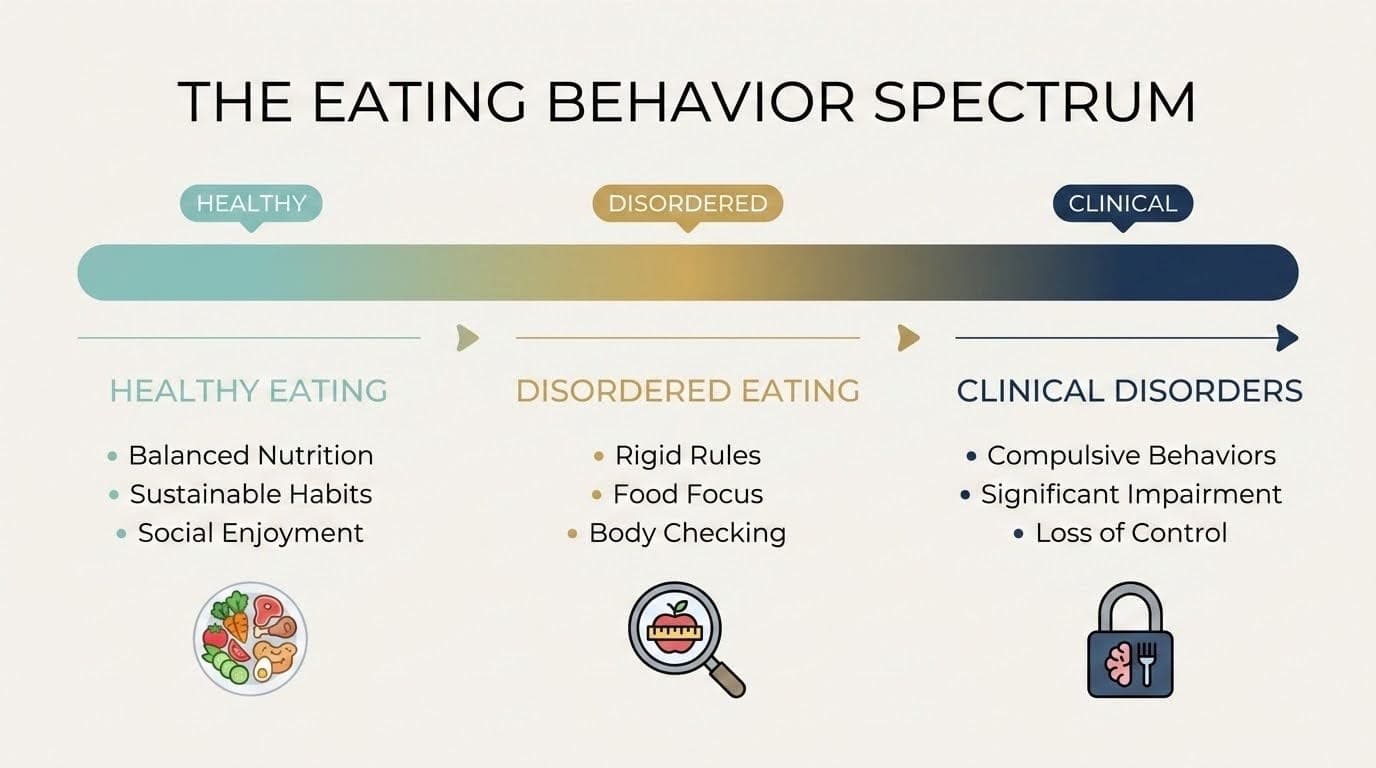
The clinical picture most people have of eating disorders (visibly extreme restriction, obvious physical deterioration) describes a small fraction of the students who are actually struggling. Most eating disorders in college don’t look dramatic. They look like habits. Choices. Discipline. That’s part of what makes them so easy to miss, in yourself and in others.
Here’s how the most common presentations actually show up in everyday college life.
Restrictive Eating and Anorexia Nervosa
It starts as being intentional about what you eat. You cut out certain foods because they make you feel better. You start tracking. You feel good, proud even, when you stay under a number. Skipping a meal starts to feel like a reasonable trade-off for staying in control of something.
What makes anorexia distinct from ordinary healthy eating isn’t the food itself. It’s the underlying logic. The rules stop being about health and become about safety. Eating feels dangerous. Not eating feels like success. The restriction intensifies over time, and the mental space it occupies grows until it’s running in the background of almost everything.
Physical symptoms (fatigue, difficulty concentrating, sensitivity to cold, loss of menstrual cycle) often show up before the student recognizes the eating as the cause. By then, the thought patterns have become deeply embedded.
Bulimia Nervosa
Bulimia often stays invisible for longer than other eating disorders, because it doesn’t necessarily change a person’s weight or appearance in ways others notice. The cycle (eating past the point of fullness or out of control, then compensating through purging, laxatives, excessive exercise, or restriction) can run entirely in private.
College is a particular environment for bulimia: the combination of stress, social eating, loss of control, and shame is exactly the fuel the cycle runs on. Students with bulimia often describe the binge as a release of something that has been building: anxiety, pressure, loneliness. The purge follows as punishment and reset. Both parts feel necessary. Both parts feel terrible.
The shame that accompanies this cycle is one of the main reasons students don’t seek help. They don’t feel sick enough. They feel like they should just be able to stop. They can’t.
Binge Eating Disorder
Binge eating disorder is the most common eating disorder in the United States, and the one least likely to be taken seriously. That’s true of clinicians who don’t know better, and of the students experiencing it.
It doesn’t involve purging. It looks like eating large amounts of food in a short period of time, often in private, past the point of comfort, and with a quality of feeling unable to stop. Afterward comes shame, disgust, and a vow to do better. Then, eventually, another episode.
For college students, binge eating often functions as emotional regulation. Stress, loneliness, boredom, anxiety: all of it gets managed, temporarily, through food. The relief is real. The shame that follows is also real. It’s not a willpower problem. It’s a pattern that has its own logic and responds to specific kinds of clinical support.
Orthorexia and Disordered Eating Patterns
Not every problematic relationship with food fits a clinical diagnosis, and that doesn’t make it less worth addressing.
Orthorexia describes an obsessive focus on eating “correctly”: clean, pure, optimized. The student who tracks every macro with increasing rigidity. Who can’t eat at a restaurant because the ingredients are unknown. Whose food rules have quietly eliminated entire social situations. Who feels genuine anxiety when they can’t control what they eat.
More broadly, disordered eating covers a range of patterns (chronic restriction, emotional eating, food rituals, compensatory behaviors) that cause real distress and interfere with daily life without meeting the full criteria for a clinical diagnosis. These patterns matter. They’re worth addressing. And they respond to the same kinds of support as formally diagnosed disorders.
If food is taking up more mental space than it used to, or more than feels right, that’s worth paying attention to, regardless of whether it has a name.
The Savannah Student Experience: Pressure, Identity, and Food
Savannah is a particular kind of college town. It’s beautiful, historically rich, and home to a student population that skews toward the creative, the driven, and the people who came here specifically to pursue something they care deeply about.
That combination (high aspiration, performance culture, a long way from home) creates its own kind of pressure. Whether you’re submitting a portfolio review, preparing for a juried critique, presenting in a competitive program, or just navigating the social landscape of a new city, the standard you’re holding yourself to is rarely low.
For SCAD students specifically, the visibility of creative work adds another layer. Your output is seen, evaluated, and compared. Your body is often part of that visible landscape too, in performance, in design, in environments that are deeply image-conscious. None of that automatically causes an eating disorder. But it can accelerate something that was already present, or provide the conditions where one takes root.
Students at Georgia Southern Armstrong, Savannah State, and other area schools carry their own versions of this pressure: academic rigor, financial stress, being the first in the family to go to college, navigating a new social world. The particulars differ. The underlying dynamic often doesn’t.
What ties it together is this: Savannah students tend to be high-functioning, which means the struggle often stays hidden longer. They’re managing it. They’re performing well enough. They don’t look like someone who needs help. That’s exactly when it’s hardest to reach out, and exactly when it matters most.
Signs It May Be Time to Talk to Someone
You don’t need to have hit a crisis point to deserve support. You don’t need a diagnosis. You don’t need to be sure.
Ask yourself honestly:
- Do I think about food, calories, or my body more than feels normal, more than other people seem to?
- Have I started avoiding meals, eating alone, or situations where food is involved?
- Do I have rules around food that I feel anxious or ashamed when I break?
- Do I eat past the point of fullness and feel out of control, then feel shame or disgust afterward?
- Am I hiding what I eat (how much, or how little) from the people around me?
- Is my relationship with my body getting harder, not easier, the longer I’m in college?
- Have friends or family said something that I brushed off?
If several of those questions landed, that’s not a reason to panic. It’s a reason to talk to someone who can help you understand what’s actually going on. The earlier that conversation happens, the better the outcomes tend to be. Eating disorders are among the most treatable mental health conditions, and among the most serious when they go unaddressed.
You don’t need to have all the answers before reaching out. You just need to be willing to start the conversation.
What Therapy for Eating Disorders Actually Involves
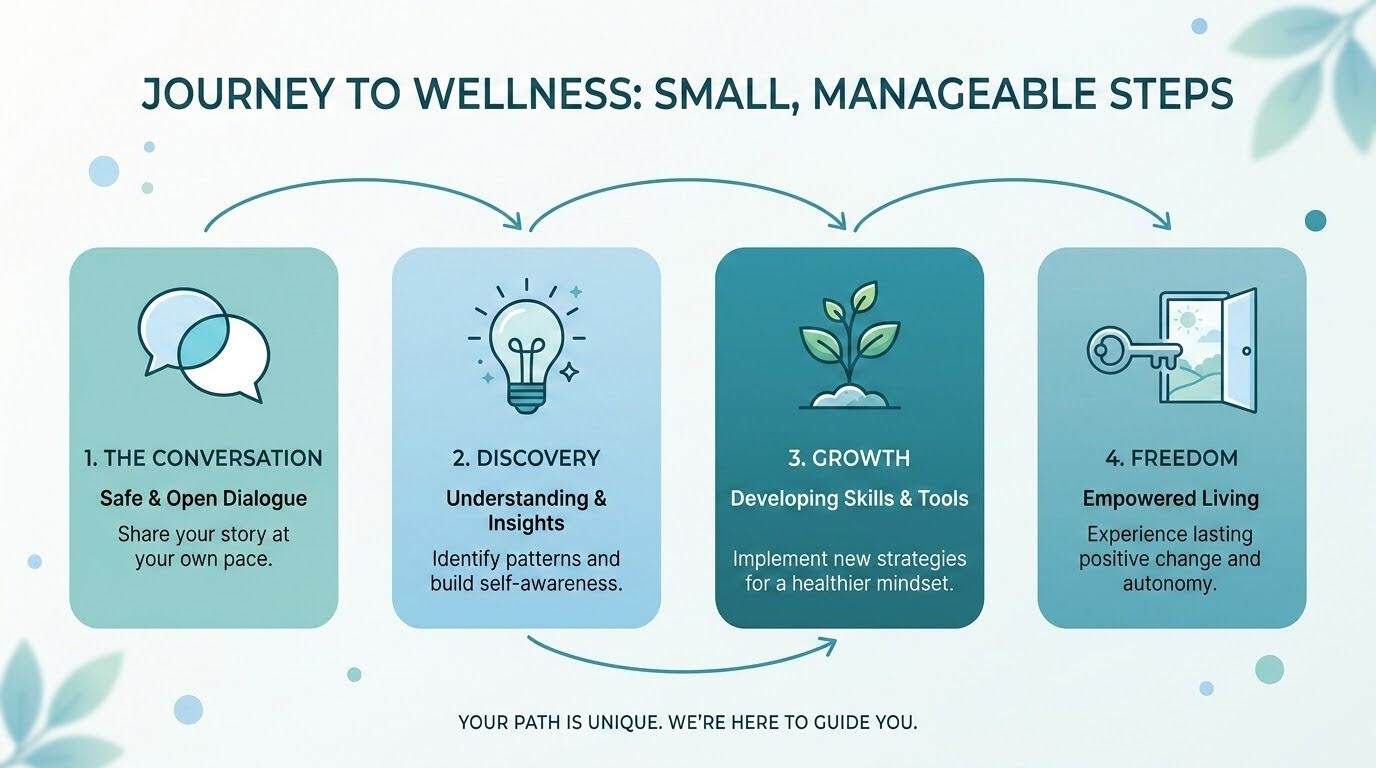
Most students who need help don’t seek it because they don’t know what they’d be walking into. They picture something clinical, confrontational, or focused entirely on food. A therapist watching them eat, being told what to put on their plate.
That’s not how outpatient eating disorder therapy works.
The first session is a conversation. Your therapist asks questions to understand your history, your patterns, and what you’re hoping for. There’s no pressure to have it figured out, no diagnosis handed down in the first hour, no homework assigned before you’re ready. The goal is to understand what’s actually happening with food, with your thoughts, with the feelings that are driving the behavior, before any treatment plan is made.
Therapy for eating disorders typically addresses the thoughts and emotional patterns underneath the food behavior, not just the behavior itself. Common approaches include Cognitive Behavioral Therapy (CBT), which helps identify and shift the thought patterns that maintain disordered eating; Dialectical Behavior Therapy (DBT), which builds distress tolerance and emotional regulation skills; and Acceptance and Commitment Therapy (ACT), which focuses on clarifying values and reducing the grip of shame-driven thoughts.
At Waters Edge Counseling, treatment plans are individualized. What you work on, at what pace, depends on your specific history and what you’re carrying. Not a standardized protocol applied to everyone.
Online counseling is also available for students who have scheduling constraints, prefer not to be seen coming and going from a therapy office, or are attending school from somewhere else in Georgia. Telehealth delivers the same clinical quality with more flexibility.
For students dealing with anxiety or depression alongside disordered eating (which is common), individual counseling can address both at once rather than treating them as separate problems. They rarely are.
You Can Get Help Without Involving Your Parents
This is the question many college students are quietly asking, and it deserves a direct answer.
If you’re 18 or older, you can seek therapy independently. You make the appointment. You attend the sessions. What you discuss stays between you and your therapist. Your parents don’t have to know.
Waters Edge is a private-pay practice, which means sessions are not billed through insurance. There’s no Explanation of Benefits that shows up on a parent’s account. No insurance trail. Sessions are billed directly to you, and documentation for out-of-network reimbursement is available if you want to pursue it later on your own terms. Rates run $90–$140 per session.
For students who prefer an additional layer of discretion, telehealth removes the need to be seen in a waiting room or at a particular address.
Privacy is a legitimate reason to hesitate, and it’s a legitimate need. It shouldn’t be the thing that keeps you from getting help. At Waters Edge, you’re in control of who knows about your care.
The Team at Waters Edge Who Works with College Students
The clinicians at Waters Edge who work most frequently with college-age clients bring a range of training that addresses both eating disorders and the co-occurring challenges that usually accompany them: anxiety, identity questions, perfectionism, and trauma.
Whitney Owens, LPC — Practice Founder
Whitney Owens founded Waters Edge Counseling in 2014 and has been a licensed professional counselor in Georgia since 2009. A graduate of Richmont Graduate University and a member of the American Counseling Association, her clinical work spans anxiety, trauma, and identity. That’s the same terrain that underlies most eating disorder presentations in college-age clients. Trained in EMDR and Internal Family Systems, Whitney brings both clinical depth and a practice culture that takes young adults seriously.
Abbie Roy, LCSW — Working Across the Lifespan
Abbie Roy is a licensed clinical social worker who sees clients from age six through adulthood, with particular experience working with younger clients navigating identity, anxiety, and behavioral patterns. Born and raised in Savannah, she brings genuine community familiarity to her work. Her approach draws on CBT and Solution-Focused Therapy, both well-supported for the thought patterns that drive disordered eating.
Gabriella Lehmkuhle, LMSW — Trauma, Anxiety, and Identity
Gabriella Lehmkuhle holds a Master of Social Work from the University of Tennessee with a specialization in clinical psychotherapy and trauma. She is trained in Brainspotting, Trauma-Focused CBT, ACT, DBT, and Psychodynamic Therapy, a breadth of modalities that makes her well-suited for the complex emotional landscape that often underlies eating disorders in college students. For clients where shame, trauma history, or identity are central to the picture, her training covers that terrain directly.
To find out which clinician is the right fit for you, our Client Care team will help match you when you reach out to schedule. You can also review the full team at the Georgia counseling team page.
Frequently Asked Questions
How common are eating disorders in college students?
More common than most people realize. Research estimates that eating disorders affect somewhere between 10–20% of college women and 4–10% of college men, and those figures likely undercount the full picture, since many students don’t seek help and many don’t identify what they’re experiencing as a clinical issue. Subclinical disordered eating patterns, which cause real distress without meeting full diagnostic criteria, are even more prevalent. The college years consistently appear as a high-risk window for both onset and escalation.
What’s the difference between disordered eating and an eating disorder?
An eating disorder is a clinical diagnosis (anorexia nervosa, bulimia nervosa, binge eating disorder, ARFID, and others) defined by specific patterns, severity thresholds, and impact on physical and psychological functioning. Disordered eating is a broader term for problematic relationships with food that cause distress or interfere with daily life but don’t meet full diagnostic criteria. Both are worth taking seriously and both respond to clinical support. The absence of a formal diagnosis doesn’t mean the struggle isn’t real.
Can eating disorders develop for the first time in college?
Yes. While many eating disorders have roots in earlier experiences, the college transition (with its combination of new independence around food, performance pressure, social comparison, and loss of familiar support) creates conditions where disorders can develop for the first time. For students who had subclinical patterns or risk factors before college, the transition can accelerate them. For others, college is genuinely where it begins.
How do I find an eating disorder therapist in Savannah, GA?
Waters Edge Counseling offers eating disorder treatment at two Savannah-area locations: our downtown office on East Bolton Street and our Wilmington Island office, as well as secure telehealth for students anywhere in Georgia. You can reach our Client Care team at 912-319-5552 or schedule online. We’ll ask the right questions to match you with the right clinician, and we can typically get you in within one to two weeks.
The Next Step Is Smaller Than It Feels
Getting to this point, reading this, taking it seriously, took something. Most students with a difficult relationship with food don’t make it this far. They close the tab, tell themselves it’s not that bad, and go back to managing it alone.
You don’t have to keep managing it alone.
Eating disorders are serious, and they’re also genuinely treatable. The earlier someone gets support, the better the outcomes tend to be. That’s not meant to pressure you. It’s just true, and it’s worth knowing.
If something in this article named what you’ve been experiencing, that’s enough reason to take the next step. You don’t need to be certain. You don’t need to have it all figured out. You just need to make one phone call or send one message.
Waters Edge Counseling has been part of the Savannah community since 2014. Our clinicians see students in person at our downtown Savannah office on E Bolton Street and at our Wilmington Island location, and we provide secure telehealth for students across Georgia.
Contact our Client Care team or schedule online. We’ll find the right fit and get you in, usually within one to two weeks.
About This Article
This article was written and published by Water’s Edge Counseling, a licensed mental health practice serving Savannah, Wilmington Island, and clients across Georgia via secure telehealth. Founded in 2014 by Whitney Owens, LPC, the practice has grown to a 17-clinician, three-location team specializing in trauma, anxiety, eating disorders, couples counseling, and more.
Clinical review was provided by Whitney Owens, LPC, practice founder and licensed professional counselor in Georgia since 2009. Whitney holds a Master in Professional Counseling from Richmont Graduate University, is a member of the American Counseling Association, and is trained in EMDR and Internal Family Systems (IFS). Her clinical background includes residential treatment, inpatient settings, and over a decade of private practice with adolescents and adults.
For a full overview of the Waters Edge clinical team, visit the Georgia counseling team page.
Water’s Edge Counseling · 420 E Bolton St Savannah, GA 31401 · 912-319-5552 · watersedgecounseling.com