


EMDR Therapy for Trauma Recovery: A Comprehensive Guide for Savannah Residents
By Water’s Edge Counseling · Reviewed by Whitney Owens, LPC · Savannah & Wilmington Island, GA · Last reviewed: April, 2026
Maybe you’ve tried to talk yourself out of it. Maybe you’ve spent years in therapy, built real insight into where it all comes from, and still wake up at 3am with your heart pounding over something that happened a decade ago. That’s not weakness, and it’s not a sign that therapy can’t help you. It’s how trauma works. It doesn’t live in the part of your brain that responds to reason.
EMDR was developed specifically for this problem. For Savannah residents, it’s available closer than you might expect.
What Is EMDR Therapy?
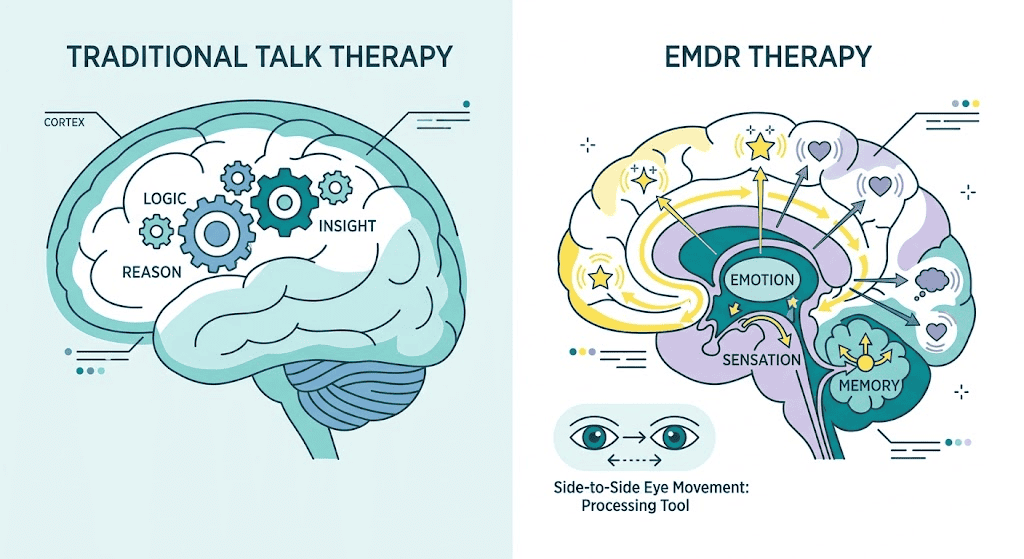
EMDR (Eye Movement Desensitization and Reprocessing) is an evidence-based psychotherapy developed by Dr. Francine Shapiro in the late 1980s. It was originally created to treat PTSD, and the World Health Organization, the American Psychiatric Association, and the U.S. Department of Veterans Affairs all recognize it as an effective trauma treatment.
The core idea: traumatic memories don’t always get filed away cleanly. Instead of moving into long-term storage the way ordinary experiences do, they can get stuck. The memory holds the same emotional charge, physical sensations, and distorted beliefs it carried when the event first happened. Years later, something triggers that memory and it comes back at full intensity, because neurologically it was never fully processed.
EMDR uses bilateral stimulation (typically side-to-side eye movements, though tapping and auditory tones are also used) to engage both hemispheres of the brain at once. Some researchers have compared this to what happens during REM sleep, when the brain naturally consolidates and integrates experience — a connection explored in research by Robert Stickgold at Harvard Medical School. The goal isn’t to erase the memory. It’s to change the way the brain holds it.
How EMDR Works: The 8 Phases Explained
A lot of articles describe EMDR as “following the therapist’s fingers while thinking about your trauma.” That’s like describing surgery as “lying on a table while someone cuts you.” The eight-phase protocol is specific, carefully sequenced, and the reason EMDR produces results that other approaches don’t always reach. The full protocol is defined and maintained by EMDRIA (the EMDR International Association), the governing body for EMDR training and standards.
Phase 1: History Taking and Treatment Planning
Before anything else, your therapist builds a thorough picture of your history. That means not just what brought you in, but your broader life, your patterns, what resources you already have, and any factors (like dissociation or significant instability) that might shape how treatment is structured. You’ll identify target memories together: the specific experiences that will be the focus of reprocessing. A good EMDR therapist doesn’t rush this. Everything that follows depends on getting it right.
Phase 2: Preparation
No trauma processing happens until you’re ready. In this phase, your therapist gives you stabilization tools: grounding exercises, containment strategies, and what’s called a “safe or calm place,” a specific internal image or memory you can return to if things get overwhelming during or between sessions.
This phase gets underestimated. EMDR doesn’t require you to white-knuckle your way through activation. The preparation work is what makes it possible to process difficult material without falling apart between appointments. That matters especially for people with complex or developmental trauma.
Phase 3: Assessment
Here your therapist helps you access the target memory in a structured way. You’ll pinpoint the image that captures the worst of it, the belief about yourself tied to that moment (the “negative cognition,” something like “I am powerless” or “It was my fault”), and what you’d rather believe instead (the “positive cognition,” such as “I did the best I could” or “I’m safe now”).
You’ll rate how true the positive belief actually feels on a scale of 1 to 7, in your gut rather than just intellectually (this is called the Validity of Cognition scale). You’ll also rate how distressing the memory currently feels on a scale of 0 to 10 (Subjective Units of Disturbance). These numbers aren’t just intake data. They guide the session and track real progress.
Phase 4: Desensitization
This is the center of it. While holding the target image, the negative belief, and the physical sensations in mind, you follow your therapist’s bilateral stimulation (moving fingers, a light bar, or handheld tappers) through sets of back-and-forth movement. After each set, your therapist asks one question: “What do you notice?” You say whatever comes up. Thoughts, images, feelings, memories, nothing at all. No analysis required.
The next set starts from wherever you landed. This continues until the distress rating drops to a 0 or 1. What people often describe afterward is hard to put into words. Not relief exactly, more like the memory is still there but it’s lost its grip. A quiet where there used to be noise.
Phase 5: Installation
Once distress is down, the focus shifts to the positive cognition. Bilateral stimulation continues while you hold the target memory alongside the new belief, until that belief stops feeling like something you’re telling yourself and starts feeling true. That’s a 6 or 7 on the VoC scale.
Phase 6: Body Scan
You scan from head to toe, holding the memory and the new belief together. If any tension or discomfort remains anywhere in the body, that becomes the focus of additional bilateral stimulation. Trauma doesn’t only live in memory. It lives in the body, and this phase is how you know the session actually finished.
Phase 7: Closure
Every session ends with grounding, full stop, regardless of how far processing got. Your therapist uses the tools from Phase 2 to make sure you leave settled. You’ll know what to expect in the days after (some clients notice continued processing, strange dreams, or shifting emotions) and you’ll have a way to log what comes up between sessions.
Phase 8: Re-Evaluation
The next session starts by checking in on everything: where the previous target landed, what shifted, what’s still live. EMDR is iterative. One memory might clear in a single session. Complex or layered trauma typically means multiple targets over time. Re-evaluation keeps things accurate rather than assumed.
What Conditions Does EMDR Treat?
EMDR started with PTSD, but the research has expanded well beyond it. A 2013 meta-analysis published in the Journal of Anxiety Disorders found EMDR to be effective across a range of trauma-related presentations, and ongoing research continues to broaden its applications. At Waters Edge Counseling, our licensed therapists use EMDR with clients working through a range of conditions, always with a thorough assessment first to confirm it’s the right fit:
- PTSD and complex PTSD: single-incident trauma and chronic, developmental, or relational trauma
- Anxiety disorders: generalized anxiety, social anxiety, and panic disorder, particularly when rooted in early threat or unpredictability
- Depression: especially when tied to unprocessed grief, loss, or adverse experiences
- Grief and complicated loss: when the mourning process has stalled
- Phobias: often traceable to a specific formative experience
- Medical trauma: distress related to diagnoses, procedures, or health crises
- Military and first responder trauma: including combat exposure, moral injury, and operational stress
- Childhood abuse and neglect
- Relational and attachment trauma
If you’re wondering whether your experience qualifies, the more useful question is whether something from your past is still affecting how you feel, think, or function today. That’s the territory EMDR works in. A conversation with a licensed therapist is the right place to start.
Wondering if EMDR is a fit for what you’re carrying? Waters Edge Counseling offers in-person sessions at our downtown Savannah and Wilmington Island locations, and secure telehealth anywhere in Georgia. Reach out to our Client Care team and we’ll match you with the right therapist and get you scheduled, usually within a week or two.
What to Expect at Waters Edge
The first question most people ask is: what actually happens in the room?
At Waters Edge, early sessions aren’t spent diving into trauma. They’re spent building your foundation: the grounding tools, the containment strategies, the internal resources that make processing feel manageable when you do get there. That part doesn’t get rushed.
EMDR sessions typically run 60 to 90 minutes, longer than a standard therapy hour, because you need enough time to open a memory, work through it, and close the session with grounding before you go. You won’t leave mid-process.
You also won’t be asked to narrate what happened in detail. EMDR works with your internal experience (the image, the sensation, the belief), not with building a verbal account of events. People who have struggled to talk about their trauma often find this a significant relief.
Because Waters Edge is a private-pay practice, your sessions aren’t shaped by insurance limits on length, frequency, or method. The treatment plan reflects what you actually need. Learn more about EMDR at Waters Edge here.

EMDR vs. Talk Therapy
A lot of people come to EMDR after years of talk therapy that gave them real understanding of their trauma without changing how it felt. That’s not a failure. It reflects how differently these approaches work on the brain.
Talk therapy, CBT included, works primarily through the prefrontal cortex (the reasoning, language-based part of the brain). It’s the right tool for a lot of things: building insight, developing coping strategies, challenging thought patterns that aren’t serving you. Waters Edge therapists use individual therapy as a standalone approach and in combination with EMDR depending on what a client needs.
But research suggests trauma is stored through processes involving subcortical structures (the amygdala, the hippocampus, the nervous system), areas that don’t respond to verbal logic the way the thinking brain does. Psychiatrist and researcher Bessel van der Kolk’s work on how trauma is encoded in the body and nervous system helped establish why talking alone often isn’t enough. EMDR works at that level directly, through bilateral stimulation and body awareness. Which is why people often describe the shift as something they felt rather than something they figured out: “I know it happened, but it doesn’t feel like mine anymore.”
The two approaches aren’t in competition. Many Waters Edge clients combine individual counseling for ongoing support with EMDR for trauma reprocessing specifically.
Is EMDR Right for You?
EMDR tends to work well for people who:
- Have specific memories that still feel raw or intrusive, even years later
- Deal with flashbacks, nightmares, or hypervigilance tied to past events
- Sense that their anxiety, depression, or relationship patterns are rooted in things that haven’t fully resolved
- Have done talk therapy, gotten insight from it, but the emotional charge hasn’t shifted
- Want to address what happened without having to talk through it in detail
It may need a modified approach, or more preparation time, for people with significant dissociation, active substance use, or limited stabilizing support outside of sessions. A proper Phase 1 and 2 assessment will sort that out. Your therapist won’t move into trauma processing until you’re ready.
EMDR is also available for kids as young as 6, supported by research specifically on EMDR with children and adolescents. Child and teen counseling at Waters Edge includes trauma-informed approaches adapted for younger clients.
Finding EMDR Therapy in Savannah
Not every therapist in Savannah who works with trauma offers EMDR, and among those who do, not all have completed formal EMDRIA-approved training or practiced the full protocol under supervision. It’s a reasonable thing to ask about when you’re vetting providers.
Waters Edge has been part of the Savannah community since 2014. Whitney Owens opened the practice in a Victorian house on Bull Street. One therapist, one office. It’s now a three-location practice with 17 clinicians. Not a high-volume clinic. Not insurance-driven. The kind of place where the intake coordinator asks what you’re dealing with before they schedule you.
The clients reflect the full range of Savannah: SCAD students under serious pressure, military families, people in their 50s working through things that happened decades ago, parents who realized their kids were struggling with something they recognized in themselves.
In-person sessions are available at 420 E Bolton St in downtown Savannah and 6703 Johnny Mercer Boulevard on Wilmington Island. For clients across the rest of Georgia, online counseling via secure telehealth covers the full state.
Frequently Asked Questions
How many EMDR sessions will I need? There’s no honest universal answer. Research shows that single-incident traumas often resolve faster than complex or developmental trauma, which layers across years. Your therapist will give you a realistic picture based on your specific history early on, not a generic estimate.
Does EMDR work if I can’t clearly remember what happened? Yes. EMDR doesn’t require a clear or detailed narrative. It works with whatever is accessible: fragments, body sensations, a vague but persistent dread. It processes from there. You don’t need to be able to tell a coherent story about what happened.
Will I have to describe the trauma in detail? No. You’ll identify the general target during assessment, but the processing itself is internal. Your therapist will ask what you’re noticing, not what happened. A lot of people choose EMDR specifically for this reason.
Is EMDR covered by insurance? Waters Edge is a private-pay practice and doesn’t bill insurance directly. We can provide documentation for potential out-of-network reimbursement depending on your plan. If cost is a question, our Client Care team is the right first call.
Can EMDR make things worse? Between sessions, things can get stirred up: vivid dreams, emotions closer to the surface, old memories that surface unexpectedly. That’s often processing continuing outside of session, not a sign something went wrong. Everyone responds differently, though, and if something feels unmanageable, tell your therapist. The whole point of Phases 2 and 7 is to keep things from destabilizing you between appointments. If adjustment is needed, your therapist will make it.
How is EMDR different from hypnosis? It isn’t hypnosis. You stay fully conscious and in control throughout. You can stop at any point. The bilateral stimulation works with the brain’s existing processing. It doesn’t put you in a trance or alter your awareness.
Can children do EMDR? Yes, and there’s solid research supporting it with younger populations. At Waters Edge, EMDR is available for clients 6 and up, with the approach adapted to age and readiness.
Take the First Step
Trauma doesn’t resolve on its own timeline just because you want it to. But it does respond to the right treatment, with someone who knows what they’re doing.
Waters Edge Counseling is taking new clients at our Savannah and Wilmington Island offices, with telehealth available across Georgia. Call 912.319.5552, email info@watersedgecounseling.com, or book online. We typically get people in within a week or two.
You’ve been carrying this long enough.
Waters Edge Counseling | 420 E Bolton St, Savannah, GA 31401 | 6703 Johnny Mercer Blvd, Wilmington Island, GA | 912.319.5552 | Serving all of Georgia via secure telehealth.
This article is for informational purposes only and does not constitute clinical advice, diagnosis, or a treatment recommendation. Please consult a licensed mental health professional to determine whether EMDR or any other approach is right for your situation.