


The Science of Healing: How EMDR Reprocesses Traumatic Memories to Restore Your Life
By Water’s Edge Counseling · Reviewed by Whitney Owens, LPC · Savannah & Wilmington Island, GA · Last reviewed: April, 2026
The Bottom Line on EMDR
EMDR (Eye Movement Desensitization and Reprocessing) is a neurobiological therapy that uses bilateral stimulation to jumpstart the brain’s natural healing process. By mimicking the REM sleep state, it reprocesses “stuck” traumatic memories from the emotional amygdala to the logical prefrontal cortex, transforming distressing triggers into neutral, historical events.
Losing your sense of safety is one of the hardest things life throws at us. Perhaps you’ve noticed that some memories don’t just stay in the past.
They feel like they are happening right now, triggered by a sudden sound, a specific scent, or a shift in the room.
In my practice at Waters Edge Counseling, I often see individuals who feel “stuck” in their own history. You might feel as though your brain has lost its ability to file away the pain.
This is where the science of EMDR steps in, offering a structured path toward restoration through specialized individual counseling in Savannah.
What is EMDR Therapy and How Does it Work?
EMDR is a neurobiological therapy that targets the way your brain stores and processes information after a traumatic event. According to the American Psychological Association, it reprocesses “stuck” memories by mimicking the REM sleep state.
While many assume therapy requires “reliving” the pain, our clinical experience shows that EMDR allows you to observe your history without being consumed by it.
Think of it as a temporary blockage in your internal neuro-circuitry. EMDR gives your brain the tools it needs to finally finish the work of healing that was interrupted by the trauma.
Perspective Insight: In our Savannah rooms, we often see the “Aha!” moment happen not through talking, but through the quiet rhythm of reprocessing. If you feel like words aren’t enough to heal the pain, explore how our EMDR approach can help you find relief.
The Adaptive Information Processing (AIP) Model: Your Brain’s Internal Filing System
At the heart of EMDR is a clinical framework called the Adaptive Information Processing (AIP) model, which suggests that symptoms arise when memories are stored in a state-specific, unintegrated form.
This model, recognized by the National Center for PTSD, provides the blueprint for how we move pain from the “active” present into the “historical” past.
Why Some Memories Get “Stuck”: The Biology of Trauma
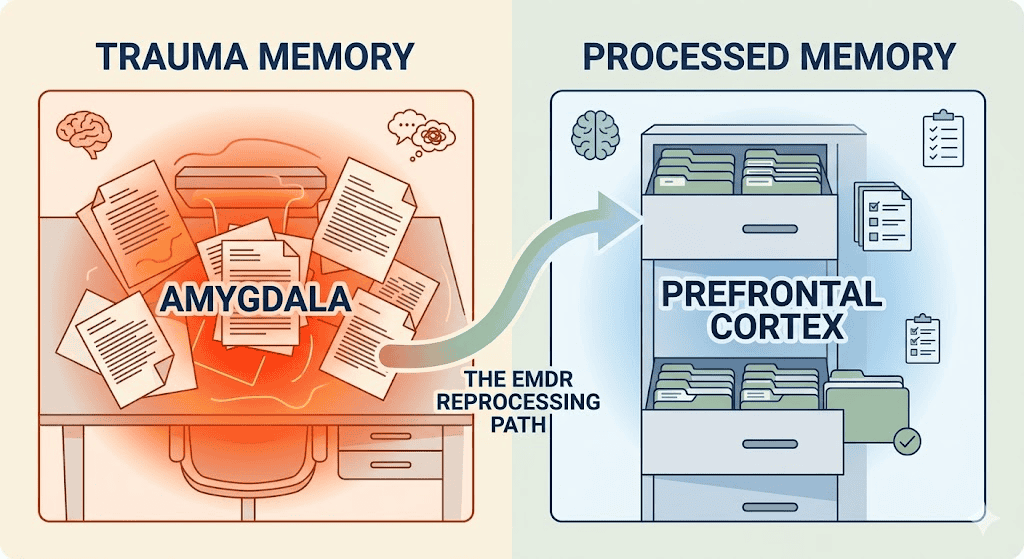
Under normal circumstances, your brain processes experiences and files them away into “History.” But during a traumatic event, the amygdala—your brain’s emergency alarm system—takes total control.
Because the system is in “survival mode,” the memory is never properly coded or filed. It stays on the “Active Desk,” raw, hot, and easily triggered.
This constant state of high alert is often a primary driver for those seeking anxiety treatment and coping skills.
From Amygdala to Prefrontal Cortex: The Integration Process
EMDR facilitates a “hand-off” of information from the emotional centers of the brain to the logical centers, allowing the memory to finally be archived. We call this Bi-Hemispheric Synchronization.
Research published in Frontiers in Psychology suggests that bilateral stimulation facilitates a conversation between the emotional right side of the brain and the logical left side.
This allows the memory to be integrated into your life story as a past event, stripped of its overwhelming emotional charge.
Beyond Eye Movements: The Science of Bilateral Stimulation
Bilateral Stimulation (BLS) is the mechanical “engine” of EMDR, using rhythmic left-right sensory input to activate both sides of the brain. A question I hear often is: “How can moving my eyes back and forth fix my trauma?”
Visual, Auditory, or Tactile? How the Brain Processes Different Inputs
While eye movements are the most common form of BLS, we also utilize rhythmic taps or auditory tones. This rhythmic stimulation creates a state of “dual awareness.” * One foot in the present: You are grounded and safe in our Savannah office.
- One foot in the past: You are observing the memory from a safe distance.
This process mirrors the neural reactivation during REM sleep, which facilitates the integration of emotional memories into cortical stores.
Subtle Invite: You don’t have to navigate these heavy memories alone. Speak with a trauma specialist in Savannah who can help you ground your nervous system before you begin the healing process.
The Secret to Success: “Phase 0” and Nervous System Readiness
Effective EMDR therapy begins with a foundation of safety, ensuring your nervous system is regulated enough to handle the work of reprocessing. We don’t believe in rushing the restorative journey.
Our clinicians prioritize Somatic Grounding—teaching your body how to feel safe and regulated before we ever touch a traumatic memory.
At Waters Edge, we have guided hundreds of Savannah residents through this exact process, ensuring they feel secure enough to do the deep work of healing.
The 8-Phase Protocol: A Step-by-Step Roadmap to Recovery
The 8-phase protocol is a highly structured clinical roadmap designed to ensure safety, stability, and lasting neurological change. It is not just “talking about your feelings.”
- History Taking: Identifying specific memory targets and current triggers.
- Preparation: Learning specific grounding techniques to manage distress.
- Assessment: Isolating the target image, negative belief, and physical sensation.
- Desensitization: Using BLS to reduce the emotional “sting” of the memory until it reaches a neutral state.
- Installation: Strengthening a new, positive belief (e.g., “I am safe now”).
- Body Scan: Ensuring no residual tension remains in the physical body.
- Closure: Returning you to a state of equilibrium at the end of every session.
- Re-evaluation: Checking progress at the start of the next session.
EMDR vs. Traditional Talk Therapy: A Comparative View
While talk therapy focuses on gaining insight through conversation, EMDR is a “bottom-up” approach that targets the nervous system directly. This makes it particularly effective when integrated into family therapy.
| Feature | Traditional Talk Therapy | EMDR Therapy |
| Primary Focus | Insight and Cognitive Understanding | Neurobiological Reprocessing |
| Speed of Processing | Variable (often long-term) | Typically Faster for Specific Trauma |
| Primary Goal | Managing and Understanding Symptoms | Resolving Root Triggers at the Source |
| Required Verbalization | High (Detail-heavy storytelling) | Moderate (Focus on sensations and images) |
The “Emotional Hangover”: What an EMDR Session Actually Feels Like
Reprocessing trauma is physically and mentally demanding work that often continues for hours or days after the session ends. We call this an emotional hangover.
Following a session, you might notice:
- Physical fatigue: A feeling as if you’ve finished a long, meaningful hike.
- Vivid dreams: Evidence of your brain continuing to file things away while you sleep.
- A sense of “lightness”: Like a physical weight has finally been set down.
Subtle Invite: If you’re feeling the weight of the past, reclaim your peace at our Wilmington Island office, providing a quiet environment for your restorative work.
Frequently Asked Questions About the Science of EMDR
Can EMDR erase my memories?
No—EMDR moves a memory from being a “Current Threat” to a “Past Fact” without causing amnesia. You will still remember the event, but you will no longer feel the “gut-punch” of the trauma.
Is EMDR a form of hypnosis?
No—you are fully awake, alert, and in total control the entire time. Unlike hypnosis, you are an active participant in the reprocessing and can stop the session at any moment.
How many sessions will it take?
While every journey is unique, many clients begin to feel a significant shift in their physical triggers within 3 to 6 sessions for a single-incident trauma.
Key Takeaways
- Neuro-Integration: EMDR moves traumatic memories from the “survival” brain (amygdala) to the “logical” brain (prefrontal cortex).
- Bilateral Stimulation: Rhythmic eye movements or taps create a “dual awareness” state, allowing for safe reprocessing without re-traumatization.
- Evidence-Based: Recognized by the APA and VA as a gold-standard treatment for PTSD and anxiety.
- Somatic Foundation: Success depends on “Phase 0″—ensuring the nervous system is regulated and grounded before reprocessing begins.
Take the Risk of Restoration
Healing isn’t just a clinical goal; it’s a return to your true self. If you are tired of being triggered by the past, it may be time to let the science of EMDR clear the path forward.
Your journey doesn’t have to be a solo climb. By clicking below, you can schedule a brief, compassionate consultation with our team to determine the best path for your unique needs.
Begin Your Healing Journey: Contact Us in Savannah
Schedule Your Consultation Online
About the Author
Whitney Owens, LPC, is the founder of Waters Edge Counseling with over 15 years of experience in restorative mental health. Her neuro-affirming mission focuses on helping clients in Savannah and across Georgia navigate complex trauma through evidence-based, somatic approaches like EMDR. Learn more about Whitney’s mission and the Waters Edge team here.
Medical Disclaimer: The information provided in this article is for educational and informational purposes only and is not intended as medical advice, diagnosis, or treatment. Always seek the advice of a qualified mental health professional or physician with any questions regarding a medical or mental health condition.
Crisis Support Resources:
- National Suicide & Crisis Lifeline: Call or Text 988
- Emergency Services: Call 911
- Crisis Text Line: Text HOME to 741741